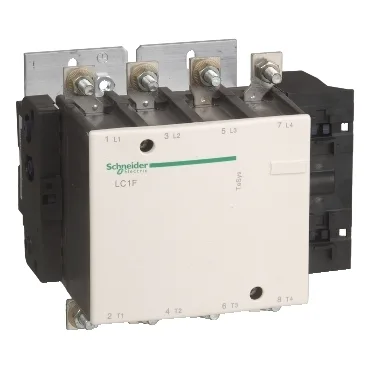
It carries 200 A at ≤440 V (at <40 °C) across four normally-open power poles, making it a fit for large heating banks, furnace control, or high-current resistive bus transfer where the load doesn't draw an inrush spike. The 110 V AC control coil (40–400 Hz) pulls 770 VA inrush and holds at 8.1 VA — the drop-out threshold sits between 0.2 and 0.55 Uc, so expect it to release cleanly on a sagging line without nuisance chatter.
This contactor is not rated for AC-3 motor starting or AC-4 plugging — if your BOM calls for motor switching, you need a different TeSys F variant with the AC-3 curve. The 4 NO pole configuration means all four contacts close together; there are no NC auxiliaries built in, so plan for an external auxiliary block if you need a status feedback signal. The 920 A rated breaking capacity per IEC 60947-4-1 confirms it can interrupt a fault without welding the main contacts, but the associated fuse recommendation (125 A aM or 200 A gG at ≤440 V) sets the upstream protection limit — don't oversize the fuse beyond that or the contactor becomes the weak link in a short-circuit event.
This part is end-of-life (EOL) per the manufacturer's lifecycle stage.
Plate-mounted — no DIN rail adapter on this frame size. The 200.5 mm width, 162 mm height, and 171 mm depth need panel layout planning; it's a substantial block. Power connections accept bar (20 x 3 mm busbar), ring lugs, or bolted connections for up to 95 mm² cable. Control wiring uses screw-clamp terminals accepting 1–4 mm² solid or flexible. Tightening torque: 10 N·m on the power circuit, 1.2 N·m on the control circuit. The IP2X front face with shrouds meets finger-probe protection per IEC 60529 and VDE 0106 — fine for a closed panel but not for washdown environments.
Altitude rating of 3000 m without derating covers most installations outside high-mountain sites. Heat dissipation runs 5.9–7.2 W total (15 W per pole in AC-1), which matters for panel thermal budgeting — don't cluster multiple units without airflow. The TH protective treatment adds tropicalisation for humid or corrosive environments.