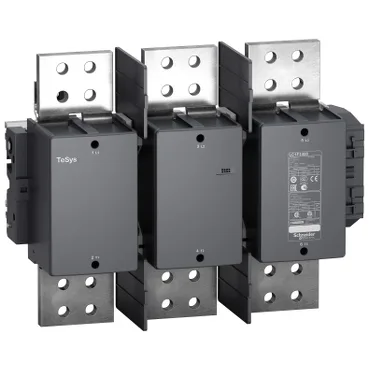
TeSys F 1400 A Contactor — LC1F1400FD
The Schneider Electric LC1F1400FD is a 3-pole contactor from the TeSys F range, rated for 1400 A in AC-1 utilisation category (resistive loads) at 40 °C. The control circuit is 110 V DC standard, with an operating range of 0.85 to 1.1 Uc and a drop-out window of 0.3 to 0.5 Uc at 55 °C. Rated breaking capacity is 2100 A per IEC 60947-4-1, and the short-time withstand current (Icw) holds 8000 A for 10 seconds at 40 °C, stepping down to 2600 A for 10 minutes. These ratings mean the contactor can handle high-fault conditions without welding or flashover — critical for panel selectivity and upstream breaker coordination.
The LC1F1400FD is end-of-life hot (EOL hot) — production has ceased. No successor order code is listed.
Compliance & Approvals
The contactor is certified to EN 60947-4-1, IEC 60947-4-1, UL 60947-4-1, and CSA C22.2 No 60947-4-1, plus JIS C8201-4-1. Overvoltage category III and protective treatment TH (tropicalised) are standard. The associated fuse rating is 1600 A gG at ≤ 440 V. These approvals cover most industrial control panels in North America, Europe, and Japan without additional component-level testing.
Plate-mounted — no DIN-rail clip. The power circuit uses bolted connections or bar connections accepting a busbar cross-section of 100 x 5 mm. Control circuit terminals are screw-clamp, accepting 1 to 4 mm² flexible or solid wire (with or without ferrule). Tightening torque is 58 N·m on the power side and 1.2 N·m on the control side. Dimensions: 438 mm wide, 332 mm high, 238.6 mm deep — plan for a substantial panel footprint and busbar routing.
Thermal & Duty Considerations
Heat dissipation is 10 W at 20 °C holding, with 150 W per pole in AC-1 duty. Inrush power at 20 °C is 2100 W. The average impedance is 0.1 mΩ at Ith 1700 A, 50 Hz. Maximum operating rate is 600 cycles per hour at 55 °C. Ambient operating temperature is -5 to 40 °C; storage range is -60 to 80 °C. These numbers matter for enclosure thermal design — the 150 W/pole figure drives ventilation or forced-air requirements in a sealed cabinet.