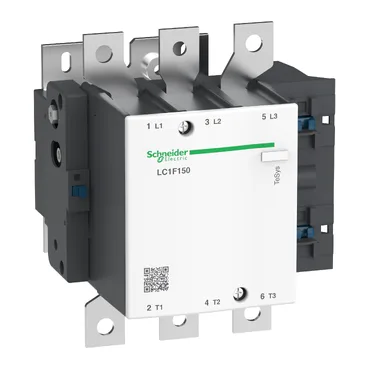
It carries a rated operational current of 250 A (AC-3 at ≤ 440 V) and switches motors up to 75 kW at 400 V AC (AC-3 duty). The coil pulls 42 V AC at 50 Hz, with an inrush of 550 VA and a hold-in draw of 45 VA — standard for this frame size. That 250 A AC-3 rating is the number that matters for motor starting: it governs the contactor's ability to make and break inductive loads under full locked-rotor current. For resistive loads (AC-1), the thermal current Ith is also 250 A, so the same contactor handles heater banks or lighting without derating. Rated breaking capacity sits at 1200 A per IEC 60947-4-1, and the contactor complies with EN 60947-4-1, IEC 60947-4-1, and JIS C8201-4-1 — so it's accepted across European and Japanese panel standards.
If you're sourcing for a BOM line that needs a drop-in replacement, the closest functional match would be a TeSys F contactor with the same 250 A AC-3 rating and a 42 VAC 50 Hz coil — but verify the mounting footprint and auxiliary wiring before committing the line.
Mounts to a plate — no DIN rail adapter on this frame. The contactor measures 170 mm high, 163.5 mm wide, and 171 mm deep. Power connections accept bar (25 x 3 mm busbar), ring-terminal lugs (120 mm² cable), or bolted connection. Control wiring uses screw-clamp terminals accepting 1 to 4 mm² flexible or solid. Tighten power terminals to 18 N·m, control terminals to 1.2 N·m. Front face achieves IP2X with shrouds fitted (per IEC 60529 and VDE 0106). The TH protective treatment means it's suitable for tropical environments — no extra conformal coating needed for high-humidity panels.
Operating conditions and derating
Runs from -40 to 60 °C ambient, stores from -60 to 80 °C. No derating required up to 3000 m altitude. Maximum operating rate is 2400 cycles per hour at 55 °C. Heat dissipation runs 12 to 16 W total; per-pole dissipation is 22 W in AC-1 and 8 W in AC-3.