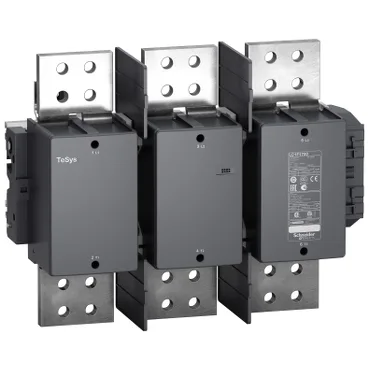
The Schneider Electric TeSys F LC1F1700FD is a 3-pole contactor rated for 1700 A in AC-1 duty (resistive loads), with a 110 V DC coil. It is plate-mounted and built for switching large resistive banks.
Mounts to a plate — no DIN rail clip. The 438 mm width and 332 mm height mean it fills a significant footprint on the backplate; plan for a 600 mm wide subpanel minimum. Power connections are bolted busbars, sized for 100 x 5 mm cross-section (three cables per phase). Control wiring uses screw-clamp terminals accepting 1 to 4 mm² flexible or solid. Tightening torque on the power circuit is 58 N.m — that's a substantial torque, requiring a torque wrench on the busbar bolts. The control circuit torque is 1.2 N.m, standard for screw terminals.
The contactor carries IEC 60947-4-1, UL 60947-4-1, and CSA C22.2 No 60947-4-1 certifications — it's accepted in North American and European installations. Rated insulation voltage is 1000 V per IEC, 1500 V per VDE Group C. Impulse withstand is 8 kV, overvoltage category III. The short-time withstand rating (Icw) is 10000 A for 10 seconds — that's the current the main poles can carry during a fault without welding, critical for coordination with upstream fuses or breakers. The associated fuse recommendation is 1600 A gG at ≤ 440 V. Operating altitude is 3000 m without derating, and the storage temperature range is -60 to 80 °C, though the operating range is -5 to 40 °C. Heat dissipation is 10 W holding (coil), with 200 W per pole under full AC-1 load — that's 600 W total from the poles, plus coil losses, so ventilation in the enclosure matters.