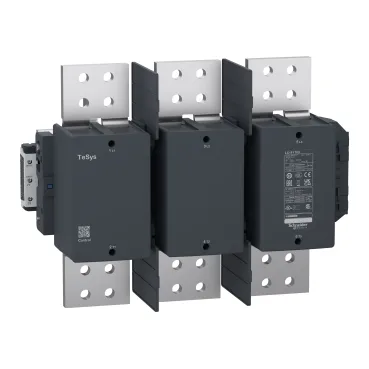
1700 A AC-1 Contactor — Sourcing and Fit
The Schneider Electric LC1F1700M7 is a TeSys F 3-pole contactor rated for 1700 A in AC-1 duty (resistive loads), with a 220 V AC 40-400 Hz control coil. The AC-1 rating is the conventional free-air thermal current (Ith) — this is the current the main poles carry continuously without switching, so it is sized for large resistive heating banks, furnace elements, or distribution switching where motor inrush is not the concern. The 1700 A figure governs the busbar and cable work: power circuit connections use bolted bars up to 100 x 5 mm cross-section, torqued to 58 N·m. For a contactor this size, the mounting is plate-only (no DIN rail). The 438 mm width and 332 mm height demand a dedicated backplate in the enclosure. Heat dissipation runs 36 W total, 200 W per pole in AC-1 — that is significant thermal load; the panel designer needs to account for natural convection or forced airflow above 40 °C ambient. The control circuit is screw-clamp terminals accepting 1 to 4 mm² flexible or solid wire. Coil hold-in power is 36 VA at 220 VAC; inrush is 2200 VA. The coil dropout threshold is 0.3 to 0.5 Uc — meaning it releases between 66 and 110 VAC, which is a standard margin for brownout ride-through on large contactors.
Lifecycle Status — End-of-Life, Sourced to Order
Because this is a high-current, large-frame contactor that was built to multiple international standards — IEC 60947-4-1, EN 60947-4-1, UL 60947-4-1, CSA C22.2 No 60947-4-1, and JIS C8201-4-1 — any replacement or alternative must also carry those approvals to maintain the panel's certification. The part also meets overvoltage category III and has a rated impulse withstand voltage of 8 kV.
Integration — Panel and Wiring Notes
Plate mount only. The depth is 238.6 mm, which fits standard 600 mm deep enclosures but leaves limited clearance for rear-access wiring. Power circuit connections are bolted busbars — plan for a busbar cross-section of 100 x 5 mm per pole, with three cables per phase. The control circuit uses screw-clamp terminals; strip length for flexible wire with ferrule is standard at 8-10 mm. The short-time withstand current (Icw) ratings give the selectivity engineer the numbers for coordination: 10,000 A for 10 seconds at 40 °C, stepping down to 3,000 A for 10 minutes. These are the thermal limits the contactor can survive under fault conditions before the upstream protective device clears. Associated fuse recommendation is 1600 A gG at ≤ 440 V. Operating time is 100 to 170 ms opening, 40 to 75 ms closing. That is typical for a large-frame contactor — not fast enough for arc-flash mitigation on its own, but adequate for normal load switching. Maximum operating rate is 600 cycles per hour at 55 °C.