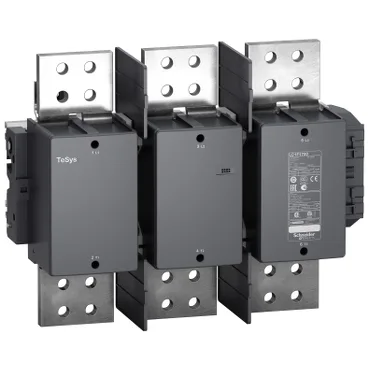
The Schneider Electric LC1F1700V7 is a 3-pole TeSys F contactor rated for 1700 A conventional free-air thermal current (Ith) and 1700 A operational current in AC-1 utilisation category — resistive loads such as large heating banks, furnace elements, or non-inductive industrial heaters. The 400 V AC control coil draws 2200 VA inrush and 36 VA hold-in power at 50/60 Hz. Plate-mounted, with power-circuit bolted connections accepting busbars up to 100 x 5 mm; control wiring lands on screw-clamp terminals accepting 1…4 mm² flexible or solid conductors.
The 1700 A AC-1 rating is the headline figure — this contactor is sized for switching resistive loads at that current, not motor starting. AC-1 duty involves minimal inrush, so the contactor's thermal capacity governs. Short-time withstand (Icw) is 10 kA for 10 s, 7.5 kA for 30 s, tapering to 3 kA for 10 min — useful for coordinating with upstream protective devices in high-fault panels. The 400 V AC control coil has an operating range of 0.85…1.1 Uc (340…440 V) and drops out between 0.3…0.5 Uc (120…200 V). Opening time is 100…170 ms, closing 40…75 ms. The coil is AC only at 40…400 Hz — not compatible with DC control schemes. Mounting is plate-only (no DIN-rail option for this frame size). The 438 mm width, 332 mm height, and 238.6 mm depth require a substantial backplate and clearance for busbar connections. Power-circuit tightening torque is 58 N.m — a torque wrench is mandatory for the bolted busbar connections.
Compliance documentation is available: the contactor is certified to IEC 60947-4-1, EN 60947-4-1, JIS C8201-4-1, UL 60947-4-1, and CSA C22.2 No 60947-4-1. Rated insulation voltage is 1000 V per IEC/UL, 1500 V per VDE 0110 group C. Impulse withstand voltage is 8 kV, overvoltage category III. Protective treatment is TH (tropicalized).
Integration notes
Heat dissipation is 36 W total coil hold-in, plus 200 W per pole in AC-1 service — 600 W total pole dissipation. This heat must be factored into enclosure sizing; forced ventilation may be needed in sealed cabinets. Maximum operating rate is 600 cycles per hour at 55 °C. Altitude derating begins above 3000 m. Associated fuse rating is 1600 A gG at ≤ 440 V for short-circuit coordination. The average impedance per pole is 0.1 mOhm at 1700 A, 50 Hz. Control circuit screw terminals accept one or two conductors; power circuit uses bolted busbar connections only — no cage-clamp or spring terminals on the main poles.