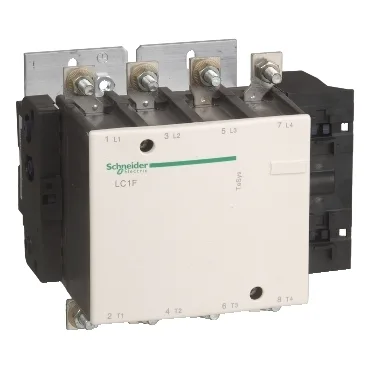
The Schneider TeSys F LC1F1854V7 is a 4-pole normally-open contactor rated for 275 A in AC-1 duty (resistive loads) at ≤440 V, with a 400 V AC control coil. It is part of the TeSys F family, designed for heavy switching of resistive loads — think large heating banks, furnace elements, or lighting stages — where the current stays sinusoidal and inrush is low. The 4 NO pole configuration means it switches all four lines simultaneously, so it fits three-phase plus neutral or dual-load isolation schemes. Mounting is plate-based (not DIN rail), so plan for a backplate or mounting chassis in the panel. If the environment is wet or dusty, this contactor needs an enclosure.
That is the number to size busbars and overloads against. Per-pole dissipation runs 25 W in AC-1 and 12 W in AC-3 — the 25 W figure drives the heat load inside the panel, so factor it into the enclosure's thermal budget. The average impedance per pole is 0.33 mOhm at 275 A, 50 Hz, which keeps voltage drop under 0.1 V per pole at full load. For higher fault levels, the associated fuse guide calls for 200 A aM or 315 A gG fuses at ≤440 V. The rated insulation voltage is 1000 V (IEC) or 1500 V (VDE 0110 group C), and impulse withstand is 8 kV, so it lives comfortably in 690 V AC systems with proper overvoltage category III coordination. The 400 V AC coil draws 1070 VA inrush and 9.9 VA holding. Drop-out range is 0.2–0.55 Uc (80–220 V), so it releases reliably on a sagging line. Closing time is 35 ms, opening 130 ms — the slow opening is inherent to AC magnet systems; if you need faster arc extinction, consider a DC-coil variant or a dedicated arc-suppression contactor.
The LC1F1854V7 carries approvals to IEC 60947-4-1, EN 60947-4-1, EN 60947-1, and JIS C8201-4-1. That covers the main industrial contactor standard for Europe and Japan. The protective treatment is TH (tropicalized) — suitable for humid, warm environments without additional conformal coating. Operating altitude is 3000 m without derating, and storage temperature spans -60 to 80 °C.