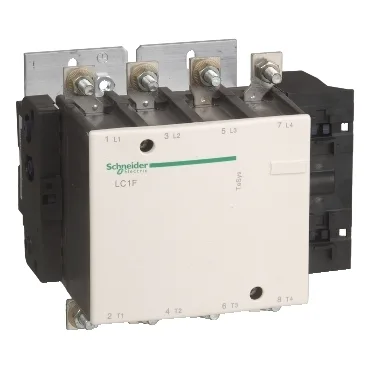
The Schneider Electric LC1F2254Q7 is a TeSys F series 4-pole contactor with a 380 V AC 40-400 Hz control coil, rated for 315 A in AC-1 duty (resistive loads) at up to 440 V and 40 °C. It switches four normally-open power poles, built for panel-mounted applications where you need to break resistive heater or lighting circuits — not motor starts. The 35 ms closing and 130 ms opening times (at rated coil voltage) are what you expect from a frame this size; the 8 kV impulse withstand voltage (Uimp) and 1000/1500 V rated insulation voltage (Ui) put it solidly inside IEC 60947-4-1 and EN 60947-4-1 compliance.
The headline number is 315 A at <= 440 V in AC-1 category — that's resistive load switching (heaters, ovens, lighting banks), not motor starting. AC-1 duty is less stressful on the contacts than AC-3 (motor) because the current and voltage are in phase at make and break. The associated fuse recommendation is 315 A gG or 250 A aM at <= 440 V, which governs your upstream protection coordination. The 4 NO pole configuration means all four poles switch the line; there are no built-in auxiliary contacts. The 380 V AC coil (40-400 Hz) has a hold-in draw of 9.9 VA and an inrush of 1070 VA — your control transformer needs to handle that surge. Plate mounting, not DIN rail, so budget for a backplate and the 35 N·m power-circuit torque spec on the bolted connections.
Mounts to a plate in the panel — no DIN-rail clip on this frame. The power circuit terminates via bar (up to 32 x 4 mm busbar), ring-terminal lugs, or bolted connection for 185 mm² cable; the control circuit uses screw-clamp terminals accepting 1 to 4 mm² flexible or solid. The IP20 front-face protection (with shrouds) is standard for enclosed gear; it's not rated for washdown environments. The 3000 m operating altitude without derating is generous — useful if the panel sits in a high-elevation plant. The 8...9.8 W heat dissipation and 32 W per pole in AC-1 mean you need to account for internal cabinet heating, especially if the contactor runs near its 2400 cyc/h maximum operating rate at 55 °C.