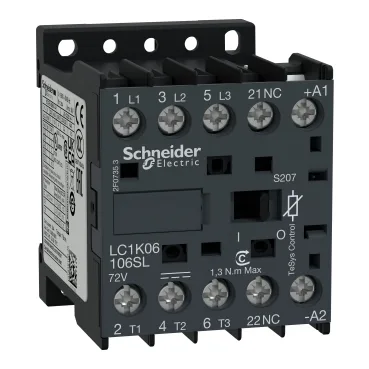
Part identity and class
It is rated for utilisation category AC-3, AC-3e, and AC-4, which means it is designed for switching squirrel-cage motors — making and breaking running loads — and for occasional plugging or inching duty under AC-4. The part carries a current lifecycle status, so it remains a qualified line item for serial production BOMs without an imminent end-of-life trigger.
The AC-3 rating governs the motor-switching capability: this contactor handles the inductive load of a running motor up to its rated current, with the inrush already accounted for in the standard. The 1.8 W heat dissipation at 20 °C (both inrush and hold-in power) is the thermal load the panel must shed — relevant when grouping multiple contactors in a sealed enclosure. Mechanical durability of 30 Mcycles and electrical durability of 1.3 Mcycles at 6 A AC-3 (Ue ≤ 440 V) give a realistic service life for high-cycle packaging or material-handling lines. The 3 NO power pole configuration with a single instantaneous 1 NO auxiliary contact covers basic three-phase motor control with one feedback or status signal. The coil includes an integral suppression device, so no external flyback diode or RC snubber is needed across the coil terminals — one less component on the BOM and one less failure point during commissioning. Standards compliance spans EN/IEC 60947-4-1, UL 60947-4-1, CSA C22.2 No 60947-4-1, GB/T 14048.4, and JIS C8201-4-1, so the part is accepted in panels destined for North America, Europe, China, and Japan without a separate qualification step.
Power circuit connections use lugs-ring terminals (external diameter 7 mm) tightened to 0.8...1.3 N·m with a 3.2 mm flat or Philips No 2 screwdriver. The 0.5 mm non-overlap distance between poles is the physical clearance to maintain — verify adjacent wiring doesn't bridge that gap. Operating altitude is 2000 m without derating — above that, consult the thermal derating curve for the coil hold-in voltage.