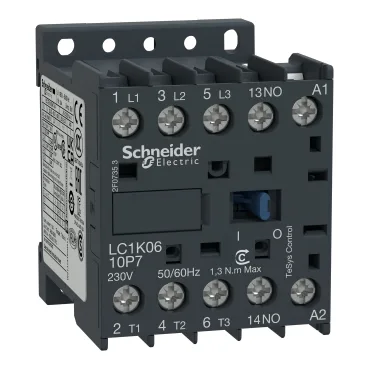
The Schneider LC1K0610B5 is a TeSys K contactor — a compact 3-pole unit rated for 6 A in AC-3 duty (motor switching) and AC-3e, up to 440 V. It carries a single normally-open auxiliary contact and a 24 V 50 Hz coil without a built-in suppressor module, so you'll need to add a flyback diode or RC snubber externally if the driving circuit demands it. The AC-3 category means it's built for starting and stopping squirrel-cage motors under load — the 6 A rating covers small motors up to roughly 2.2 kW at 400 V. The AC-3e suffix confirms it meets the energy-efficiency test profile for contactors in motor circuits.
Screw-clamp terminals accept 1.5 to 4 mm² solid or 0.34 to 2.5 mm² flexible with ferrules; torque range is 0.8 to 1.3 N·m, which is typical for this frame size. Heat dissipation is 1.3 W at coil hold-in, so no special ventilation is needed in a standard enclosure.
The 6 A AC-3 rating is the headline number, but the electrical durability tells the real story: 1.3 million cycles at 6 A AC-3, versus only 50,000 cycles at 36 A AC-4 (inching/plugging duty). If your application involves frequent jogging or reversing, the AC-4 life is the limiting factor — plan for replacement sooner. Mechanical durability is 10 million cycles, so the coil and armature will outlast the contacts under heavy AC-4 use. The minimum switching capability is 5 mA at 17 V for signalling circuits — useful if you're switching a PLC input or a low-power relay in the same contactor block. Below that threshold, the oxide film on silver-alloy contacts may not break down reliably.
Certified to EN/IEC 60947-4-1, UL 60947-4-1, CSA C22.2 No 60947-4-1, and JIS C8201-4-1 — covers the major industrial markets globally. Also listed for IEC 60335-1 and UL 60335-2-40, which matters if the contactor ends up in a heating or refrigeration appliance circuit. Flame retardance is V-1 per UL 94.