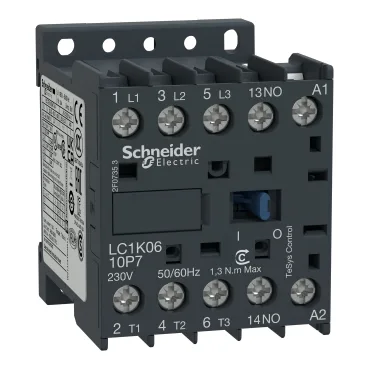
Part identity and motor-duty rating
The Schneider Electric LC1K0610P5 is a TeSys K series 3-pole contactor rated for 6 A in AC-3 and AC-3e duty up to 440 V, with a 230 V 50 Hz coil and one normally-open auxiliary contact. The AC-3 category covers starting and stopping of squirrel-cage motors — the 6 A rating corresponds to switching a motor load up to roughly 3 kW at 400 V three-phase. AC-3e is an extended electrical endurance variant of the same duty. Coil hold-in power is 4.5 VA at 20 °C, with inrush of 30 VA. The coil drops out at or above 0.20 Uc below 50 °C, ensuring positive opening on undervoltage. No built-in suppressor module — if your control circuit requires coil surge suppression, add a separate RC snubber or varistor across the coil terminals.
Electrical endurance and switching life
Rated electrical durability is 1.3 million cycles at 6 A AC-3 or AC-3e, and 50,000 cycles at 36 A AC-4 (plugging/inching duty) at voltages up to 440 V. Mechanical endurance is 10 million cycles. The B10d value for safety-related circuits is 1,369,863 cycles under nominal load per EN/ISO 13849-1, or 20 million cycles with mechanical load only — relevant if this contactor is used in a machine safety chain where the auxiliary contact signals contactor state. Maximum operating rate is 3600 cycles per hour. Minimum switching capability for signalling circuits is 5 mA at 17 V — below that, the silver-alloy contacts may not reliably wet, so use a dry-circuit relay for logic-level signals.
Physical integration and wiring
IP20 finger-safe protection per VDE 0106; the terminals are not touch-safe when wired, but the enclosure prevents accidental contact from the front. Screw clamp terminals accept 1.5 to 4 mm² solid or 0.34 to 2.5 mm² flexible with ferrule. Tightening torque is 0.8 to 1.3 N·m (No. 2 Phillips or 6 mm flathead). Heat dissipation is 1.3 W — negligible for thermal budgeting inside a panel, but worth noting if many contactors are ganged in a sealed enclosure.