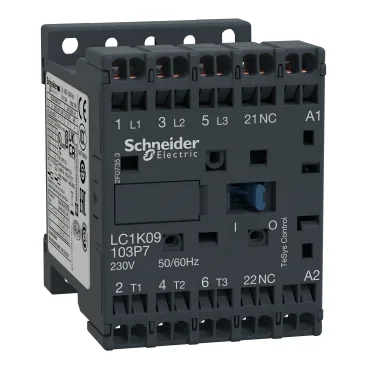
The LC1K09013P7 is a 3-pole contactor from the Schneider TeSys K range, rated 9 A in AC-3 duty at 440 V. That AC-3 category covers squirrel-cage motor starting — switching inductive loads during running, not just resistive make/break. The 9 A figure is the motor current it handles, so it's sized for small motors up to roughly 4 kW at 400 V three-phase. The coil is 230 V AC, 50/60 Hz, with a hold-in draw of 4.5 VA and inrush of 30 VA at 20 °C. No built-in suppressor module, so plan for external RC snubber or varistor if the PLC output driving it needs protection. It carries one normally-closed instantaneous auxiliary contact (1 NC) built in. That's enough for a feedback interlock or a status signal back to the controller.
Spring terminals accept one solid or two flexible cables 0.75–1.5 mm², no ferrules needed. Strip length is about 8 mm; the spring cage holds solid and stranded alike without retightening. IP2X finger protection per VDE 0106 means it's safe for open-panel mounting where operators might reach in. No washdown rating — keep it dry or in a sealed enclosure.
Durability and reliability numbers that matter
Mechanical life is 10 million cycles — the contactor itself will outlast most machines. Electrical durability at the AC-3 rating is 1.3 million cycles, which is strong for a compact frame. At AC-4 (plugging/inching) it drops to 20,000 cycles, so don't use it for frequent reversing without derating. Safety reliability B10d is 1,369,863 cycles at nominal load per EN/ISO 13849-1. That's a solid number for a safety-related switching element in a Category 2 or 3 architecture. Heat dissipation is 1.3 W — negligible for panel thermal budgeting. Maximum operating rate is 3600 cycles per hour, so it can keep up with fast indexing or cycling loads.