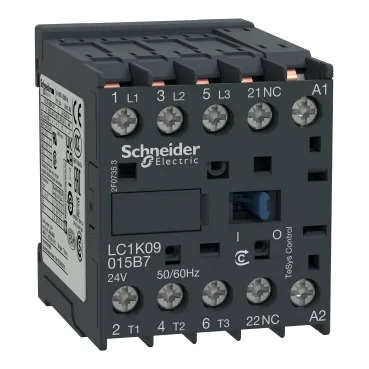
The Schneider Electric LC1K09015FE7 is a TeSys K three-pole contactor rated 9 A in AC-3 duty at ≤440 V, with a 115 V AC coil and one normally closed auxiliary contact. At 20 A AC-1 it handles resistive heater banks, but the 9 A AC-3 line is what you size against for a pump, fan, or conveyor motor. The 115 V AC coil draws 30 VA inrush and 4.5 VA hold-in power at 20 °C. The control voltage limits are 0.8 to 1.15 times the rated control voltage Uc for operation, and dropout occurs at ≥0.20 Uc below 50 °C — meaning the coil will reliably drop out before the voltage sags low enough to cause contact welding on a brownout. Minimum switching capability is 5 mA at 17 V for the signalling circuit, so this contactor can switch low-level PLC inputs or pilot lights without needing a separate interface relay — useful when the load side is a dry contact signal rather than a motor.
Where it goes and what it connects to
This contactor mounts on a printed circuit board via solder pins with a 0.035 mm external diameter. The 45 mm width, 58 mm height, and 57 mm depth footprint fits standard TeSys K panel layouts. IP2X finger protection per VDE 0106 means it is safe for open-panel mounting where incidental contact is possible, but not for washdown environments. The 3 NO power poles and 1 NC instantaneous auxiliary contact give you one normally closed feedback path for status monitoring or electrical interlocking without adding an auxiliary block. The 0.5 mm non-overlap distance between NO and NC transitions ensures break-before-make timing on the auxiliary circuit.
Durability and safety reliability
Electrical durability is rated at 1.3 million cycles at 9 A AC-3, 1.3 million at 9 A AC-3e, 160,000 cycles at 20 A AC-1, and 20,000 cycles at 54 A AC-4. The AC-4 figure (plugging/inching duty) is the wear-out limit — if your application does frequent reversing or inching, expect contact life around 20,000 operations at full load. Mechanical durability is 10 million cycles, so the coil and armature outlast the contacts under heavy switching. Safety reliability per EN/ISO 13849-1 gives a B10d of 1,369,863 cycles under nominal load and 20,000,000 cycles under mechanical load only. This means the contactor is suitable for safety-related control circuits up to a certain mission time — the B10d figure feeds directly into the PFHd calculation for the safety function.