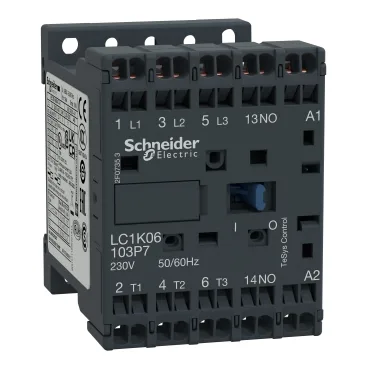
The Schneider Electric TeSys LC1K09103M7 is a 3-pole contactor rated for motor control in AC-3 and AC-3e utilisation categories at 9 A, 440 V. For resistive loads (AC-1) it carries 20 A, and for plugging/reversing duty (AC-4) it handles 54 A but with a sharply reduced electrical endurance of 0.02 Mcycles. The coil is 220-230 V AC, 50/60 Hz, drawing 30 VA inrush and 4.5 VA hold-in at 20 °C. Drop-out threshold is at least 20 % of control voltage below 50 °C, per the datasheet. A single normally-open instantaneous auxiliary contact is built in. The contactor is supplied without a built-in coil suppression module — if you are driving it from a PLC output or a solid-state relay, you will need to add a flyback diode or RC snubber across the coil externally.
The LC1K09103M7 uses spring terminals — no screwdriver torque required. Each pole accepts one solid conductor 0.75-1.5 mm² or two flexible conductors without ferrules in the same range. The 45 mm width and 58 mm height fit the standard DIN-rail footprint for the TeSys K frame, so it clips onto the rail and occupies one modular space. Under full AC-3 load at 9 A, electrical endurance is 1.3 Mcycles — that is the figure to use for maintenance planning. The maximum operating rate is 3600 cycles per hour, so it can keep pace with a fast-cycling machine. Shock and vibration ratings are specified per IEC 60068-2-27 and -6: the contactor holds closed through 10 Gn on X and 15 Gn on Y/Z axes, which is adequate for most industrial machinery but not for extreme mobile or rail-bogie applications.
Safety and signalling circuit considerations
For safety-related control circuits, the contactor carries a B10d value of 1,369,863 cycles at nominal load per EN/ISO 13849-1, and 20,000,000 cycles with mechanical load only. The minimum switching capability for the signalling circuit is 5 mA at 17 V — below that, the auxiliary contact may not reliably wet the circuit, so verify your PLC input sink current against this floor.