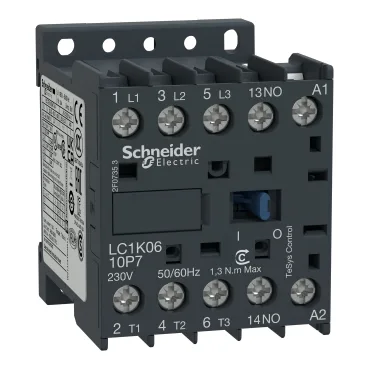
The Schneider Electric LC1K0910P5 is a TeSys K three-pole contactor rated 9 A in AC-3 (motor switching) and AC-3e duty at up to 440 V, with a 230 V 50 Hz coil and one normally open instantaneous auxiliary contact.
The 9 A AC-3 rating is the motor-switching current — it governs the maximum full-load current of a standard three-phase induction motor this contactor can handle across its electrical life. For resistive loads (AC-1), the same contactor carries 20 A, but the electrical endurance drops to 0.16 Mcycles at that level. The AC-4 rating (54 A) applies to inching or plugging duty and is limited to 0.02 Mcycles, so it is not intended for frequent reversing without a derating check. Mechanical durability is rated at 10 Mcycles, while electrical durability at 9 A AC-3 is 1.3 Mcycles — the contactor will outlast many smaller machines before the power poles need replacement. The B10d value of 1,369,863 cycles at nominal load (per EN/ISO 13849-1) supports use in safety-related control circuits where the contactor is part of the fault-exclusion path. The coil draws 30 VA inrush and 4.5 VA hold-in at 20 °C, with no built-in suppressor module. That means an external RC snubber or varistor is needed across the coil if the control circuit drives inductive loads nearby — the lack of internal suppression is a common integration point. Minimum switching capability is 5 mA at 17 V for signalling circuits, so it can reliably switch low-level PLC or relay signals without contact wetting issues — a useful detail when the auxiliary contact is used for status feedback.
The contactor is certified to EN/IEC 60947-4-1, UL 60947-4-1, CSA C22.2 No 60947-4-1, and JIS C8201-4-1, covering the main power switching standard for contactors and motor-starters. It also meets IEC 60335-1 Clause 30.2 and Annex JJ of UL/CSA 60335-2-40, which are relevant for appliance and HVAC applications. Flame retardance is V1 per UL 94, and the IP20 finger-safe terminals comply with VDE 0106.
The LC1K0910P5 is listed as obsolete by Schneider Electric. If the design can accept a parametric substitute, a current-production TeSys K contactor with the same coil voltage and pole configuration is the natural cross-reference; verify the auxiliary contact arrangement and physical footprint against the panel layout.
Screw clamp terminals accept one or two conductors up to 4 mm² solid or 2.5 mm² flexible with ferrule, torqued to 0.8–1.3 N·m. The 1 NO auxiliary contact is pre-wired; no add-on block needed for basic status feedback.