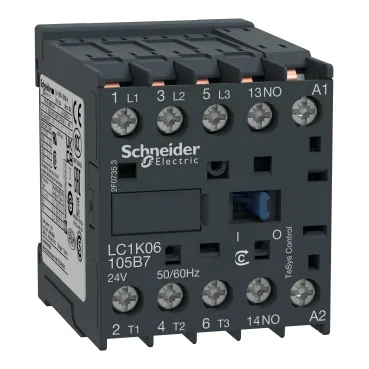
The LC1K12105P7 is a 3-pole TeSys K contactor rated 12 A in AC-3 (motor switching) and AC-3e duty at 440 V, with a 230 V AC coil. The AC-1 rating (20 A resistive) applies to heater banks or lighting, not motor starts. For high-inertia or plug-reverse applications, the AC-4 rating (72 A at ≤440 V) covers the worst-case inrush, but electrical durability drops to 0.02 Mcycles at that level — expect to budget for replacement if your cycle profile includes frequent reversing. The 1 NO auxiliary contact is built into the base unit, rated for signalling circuits down to 5 mA and 17 V minimum switching — enough for a PLC digital input or a status lamp, but not for pilot-duty loads without derating. The coil draws 30 VA inrush, 4.5 VA hold-in at 20 °C, and dissipates 1.3 W continuously. That 1.3 W matters in a crowded panel: it's low enough to skip forced cooling in most enclosures, but if you're stacking ten of these on a DIN rail, add it to your thermal budget.
Global approvals are already in place: EN/IEC 60947-4-1, UL 60947-4-1, CSA C22.2 No 60947-4-1, plus JIS and GB/T equivalents. That covers most industrial jurisdictions without a separate certification project. The UL 94 V1 flame-retardance rating on the housing means it passes the vertical burn test — relevant for panel builders who need to document material compliance per NFPA 79.
The IP2X finger protection (VDE 0106) means it's safe for open-panel mounting where operators might reach inside. Solder-pin termination (0.035 mm pin diameter) is intended for PCB mounting or quick-connect tab receptacles, not screw-clamp ring terminals — verify your wiring method before committing the panel layout. The TC protective treatment (IEC 60068, DIN 50016) adds corrosion resistance for mildly aggressive atmospheres — think coastal plant air or unheated warehouses, not chemical splash zones.
Durability and cycle life for production planning
Mechanical life is 10 Mcycles — the contactor will outlast most machines if the coil and main poles are not electrically stressed. Electrical durability depends on the load: 1.3 Mcycles at 12 A AC-3, 0.3 Mcycles at 20 A AC-1, and only 0.02 Mcycles at 72 A AC-4. If your application cycles a motor under load every 10 seconds (3600 cycles/hour max), the AC-3 life translates to roughly 360 hours of continuous cycling — plan a PM interval well before that. Safety reliability is quantified with B10d values per EN/ISO 13849-1: 1,369,863 cycles under nominal load (contact with load), 20,000,000 cycles under mechanical load only. For a safety circuit that monitors the NO auxiliary, the B10d at nominal load is the figure to use in your PFHd calculation.