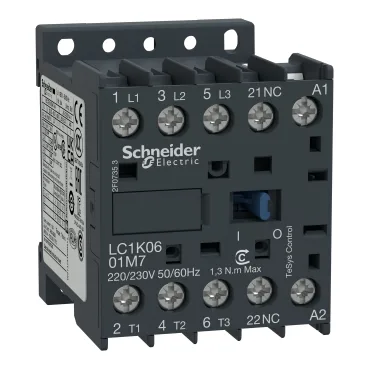
The Schneider Electric LC1K1601U7 is a TeSys K 3-pole contactor rated for 16 A in AC-3 utilisation category at ≤ 440 V, meaning it is sized for switching three-phase induction motors up to that current in full-voltage starting duty. The coil is wound for 230…240 V AC 50/60 Hz, and the auxiliary block carries one normally-closed (1 NC) instantaneous contact. AC-3 and AC-3e ratings cover across-the-line starting of squirrel-cage motors — the load type that accounts for the majority of contactor applications in industrial control panels. The electrical durability is quoted at 1.3 million cycles at 16 A under AC-3, which gives a realistic service life expectation for a machine that cycles several times per shift.
The LC1K1601U7 carries certification to EN/IEC 60947-4-1, UL 60947-4-1, CSA C22.2 No 60947-4-1, and JIS C8201-4-1, so it is accepted in European, North American, and Japanese installations without additional component-level testing. It also references IEC 60335-1 and UL 60335-2-40 for appliance applications — relevant if the contactor lands inside a packaged HVAC or refrigeration unit.
Mounting, wiring, and panel fit
Screw-clamp terminals accept one or two conductors: 1.5…4 mm² solid, 0.75…4 mm² flexible without ferrule, or 0.34…2.5 mm² flexible with ferrule. Tightening torque is 0.8…1.3 N·m with a No 2 Phillips or Pozidriv bit, or a 6 mm flat blade. The coil draws 30 VA inrush and 4.5 VA holding at 20 °C, dissipating 1.3 W. No built-in suppressor module is fitted, so if the coil is driven by a PLC output or a solid-state relay, an external RC snubber or free-wheel diode must be added across the coil terminals to protect the driver from the inductive kick.
The contactor withstands 10 Gn shocks on the X axis and 15 Gn on Y and Z axes when closed, and 4 Gn vibration (5…300 Hz) in the closed state — figures that suit it for installation on machinery subject to moderate impact or continuous vibration, such as compressors or conveyor drives. Maximum operating rate is 3600 cycles per hour, and mechanical durability is 10 million cycles.