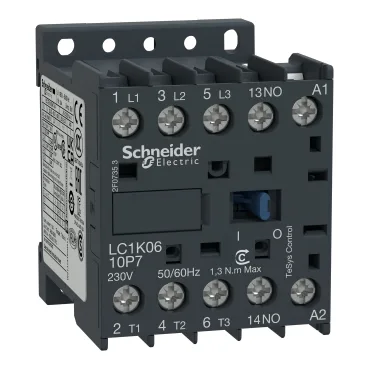
The Schneider Electric LC1K1610E7 is a TeSys K contactor — a 3-pole, 16 A AC-3 device rated for motor control at up to 440 V. The AC-3 category means it's designed to switch squirrel-cage motors: making and breaking stalled-rotor currents during starting, then carrying the running load. The 16 A AC-3 rating is the real-world motor current it handles, not a resistive-heater figure. It carries a single normally-open instantaneous auxiliary contact (1 NO) for feedback or interlocking. The coil is 48 VAC, 50/60 Hz, drawing 30 VA inrush and 4.5 VA holding at 20 °C.
Sizing and fit for the panel
The LC1K1610E7 mounts to either a DIN rail or a plate (screw-fixed). The screw-clamp terminals accept one or two conductors: 1.5 to 4 mm² solid, or 0.75 to 4 mm² flexible without ferrule, or 0.34 to 2.5 mm² flexible with ferrule. Tightening torque is 0.8 to 1.3 N·m (Phillips No 2, flat 6 mm, or Pozidriv No 2). The protective treatment is TC per IEC 60068 and DIN 50016, meaning it's suitable for tropical climates with condensation risk. For washdown or outdoor exposure, note the IP2X rating is finger-safe only — not water-sealed.
Durability and switching performance
Mechanical durability is 10 million cycles. Electrical durability at 16 A AC-3/AC-3e at ≤440 V is 1.3 million cycles — that's the contact wear life under motor-switching duty. Maximum operating rate is 3600 cycles per hour, so it can keep pace with a fast-cycling machine. Coil operating time is 10 to 20 ms for both closing and opening. The coil drops out at ≥0.20 Uc (below 9.6 V for a 48 V coil), which gives reliable dropout on undervoltage. For safety circuit integration, the B10d value is 1,369,863 cycles with nominal load per EN/ISO 13849-1, and 20,000,000 cycles with mechanical load only. Minimum switching capability is 5 mA at 17 V for signalling circuits — important to verify if you're using low-power PLC inputs through the aux contact. The coil has no built-in suppressor module; you'll need an external RC snubber or varistor if driving from a PLC output or if the coil is in a sensitive circuit.