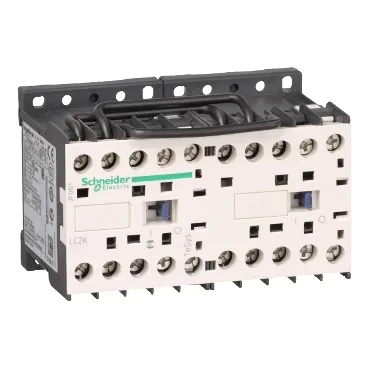
The 3 mOhm average impedance per pole keeps heat dissipation down to 1.3 W at rated current. The mechanical interlock between the two contactor halves is built into the assembly — you get positive break before the other side closes, which is the whole point of a reversing contactor for motor direction control or source transfer.
For motor reversing (AC-3 duty), you'd need to derate significantly; this part's electrical durability of 0.18 million cycles at 20 A AC-1 tells you it's not intended for frequent motor starting. The mechanical durability of 5 million cycles is the theoretical limit with no load. The 400 V AC coil draws 30 VA inrush at 20 °C, holding in at 0.8 to 1.15 times nominal voltage and dropping out between 0.2 and 0.75 Uc. That's a standard AC coil curve — if your control transformer sags below 320 V, this contactor may drop out. Operating time is 10 to 20 ms for both closing and opening. Breaking capacity is 110 A at 415/440 V, 80 A at 500 V, and 70 A at 690 V — that's the fault current it can interrupt once, not the continuous rating. The associated fuse recommendation is 25 A gG or 25 A aM on the power circuit. Mounts on DIN rail or plate, and the screw-clamp terminals accept 1.5 to 4 mm² solid or 0.75 to 4 mm² flexible. Tightening torque is 0.8 to 1.3 N·m. IP20 finger protection per VDE 0106 means it's safe for open panel mounting.
Where you'd use this
This is a control contactor for reversing applications — think conveyor direction change, fan forward/reverse, or pump alternation in a panel where you need mechanical interlock between the two directions. The preassembled busbar saves panel build time vs. wiring two separate contactors with an external interlock. At 3600 cycles per hour maximum operating rate, it's fine for occasional reversing but not for high-speed jogging.
Approvals include EN/IEC 60947-4-1, UL 60947-4-1, CSA C22.2 No 60947-4-1, and JIS C8201-4-1, plus GB/T 14048.4 for China. That covers most global panel certifications. Flame retardance is V1 per UL 94, and the protective treatment meets IEC 60068 and DIN 50016 for tropical climate resistance.