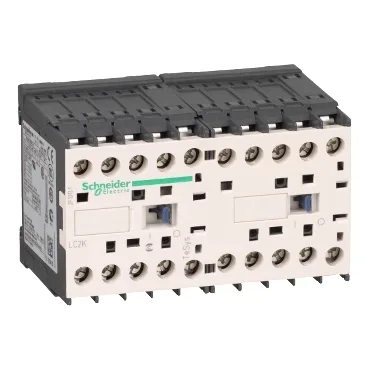
It switches a three-phase motor in both directions from a single 230…240 V AC coil signal, rated 16 A in AC-3 duty at ≤440 V (cites:,). That AC-3 rating means it handles starting and stopping of squirrel-cage motors under load — the normal use case for a reversing contactor on a conveyor, pump, or fan direction change.
The 16 A AC-3 figure at ≤440 V is the headline: it tells you the contactor set can make and break motor inrush current (typically 6–8× FLA) for a motor up to roughly 7.5 kW at 400 V. The utilisation category also covers AC-4, which is plugging and inching — frequent reversals under load — but that duty derates the current; for repeated reversing cycles, size up if the motor draws more than about 10 A. That is a standard control voltage across European and many Asian panels; if your control circuit runs 24 V DC or 110 V, this is not the coil variant you need. IP20 protection (cites:) means it is safe from finger contact but not from dust or moisture — it belongs inside a panel, not on a washdown line. The operating range is -25…50 °C ambient, with no derating up to 2000 m altitude (cites:,).
Construction and panel fit
This is a 3-pole (3 NO main poles) reversing contactor with one normally-open auxiliary contact built in (cites:,). The reversing busbar is preassembled — you mount the unit on a DIN rail, land the line and load wires, and connect the coil. The unit is flame-retardant to UL 94 V-1 and NF F 16-101/-102 (cites:), which matters for rail and transit applications where fire-smoke-toxicity requirements apply. Mechanical robustness is specified for shock and vibration per IEC 60068-2-27 and -6 — the contactor holds closed through 10 or 15 Gn shocks depending on axis, and withstands 4 Gn vibration closed (cites:).