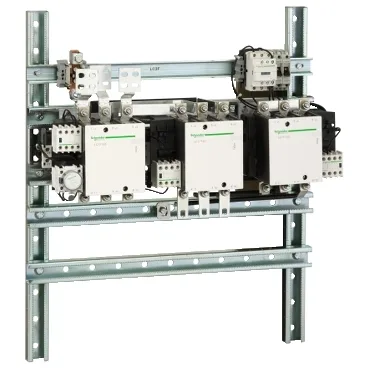
It handles 200 kW at 380/400 V AC and 220 kW at 440 V AC, 50/60 Hz, making it a direct fit for medium-voltage induction motor starts on conveyor, pump, or compressor loads where reduced inrush is required. The AC-3 rating means it switches motor loads at full current during starting and disconnects the motor under running conditions — so the 200 kW figure at 400 V is the real-world motor power you can commit to the BOM line. Mechanical durability is 10 Mcycles, which under a 2400 cycles/hour max operating rate at 55 °C gives years of service in a high-takt line. The closing time is 20 to 35 ms, opening 7 to 15 ms — deterministic enough for a body-shop weld cell where every cycle is timed against the PLC scan.
The rated breaking capacity is 1800 A per IEC 60947-4-1, and the rated making capacity is 2250 A. The associated fuse rating is 315 A gG or 250 A aM at ≤440 V — size the upstream protection to these values, not the motor FLA alone. Rated insulation voltage is 1000 V per IEC 60947-4-1 and 1500 V per VDE 0110 group C. This gives headroom for 690 V systems if the application requires it, though the motor power table stops at 440 V. The control circuit is 48 V AC 50/60 Hz, with operational limits of 0.85 to 1.1 Uc and dropout at 0.35 to 0.55 Uc — verify your control transformer output stays within that band. Heat dissipation is 18 to 24 W. In a sealed enclosure without forced ventilation, that adds up across multiple starters — plan for airflow or derate the ambient.
Standards compliance includes EN 60947-1, EN 60947-4-1, IEC 60947-4-1, JIS C8201-4-1, and IEC 60947-1. The IP20 front face with shrouds per IEC 60529 and VDE 0106 means it's finger-safe from the front in a panel, but the power circuit connections are bolted or lug-type — the enclosure door must be interlocked for live access.
Mounting support is plate-mounted — not DIN-rail snap-on. The footprint is 525 mm wide, 235 mm deep, and 110 mm high. That's a large assembly; verify the backplate or sub-panel has clearance for the 525 mm width plus cable bending radius on the power-side lugs (185 mm² max). The power circuit uses M10 bolts, so torque to 35 N·m. The pre-wired assembly includes 1 NC + 1 NO on the star contactor, 2 NC + 1 NO on the line contactor, and 1 NC + 2 NO on the delta contactor. That's enough auxiliary contacts for basic feedback to the PLC without adding a separate block. Control wiring is screw-clamp terminals accepting 1 to 4 mm² flexible with ferrules. Above that, the air dielectric and cooling degrade — but for most installations below 1000 m, no adjustment is needed.