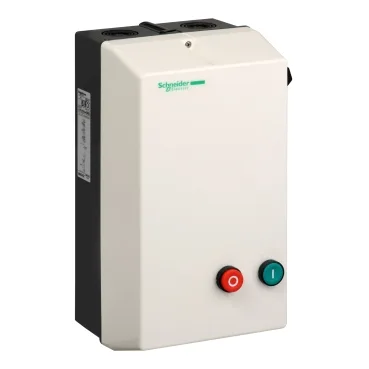
The LE4D09G7 is a TeSys LE enclosed direct-on-line (DOL) starter from Schneider Electric, rated for a conventional free air thermal current (Ith) of 9 A and a control circuit voltage of 120 V AC at 50/60 Hz. It is a self-contained motor starting unit combining a contactor and overload protection in a polycarbonate enclosure, designed for standard industrial environments. The unit is rated for AC-3 utilisation category, meaning it is suited for starting squirrel-cage induction motors and switching them off only after they are up to speed. Motor power ratings span 2.2 kW at 220/230 V AC up to 5.5 kW at 500 V AC, with 4 kW available across the common 380-440 V AC range at 50/60 Hz. This makes it suitable for installation in washdown areas or environments where the starter may be subjected to hose cleaning or incidental mechanical contact.
The only viable sourcing path for the LE4D09G7 is the surplus and broker channel. We can source it against a firm RFQ, confirming availability and condition.
The 9 A conventional free air thermal current (Ith) is the continuous current the starter's main power path can carry in open air without exceeding temperature rise limits. The 120 V AC control coil is a fixed specification — the starter cannot be field-converted to a different control voltage. Dimensions are 330 mm high, 186 mm wide, and 175.5 mm deep. The polycarbonate enclosure has multiple cable entry points (ISO20, ISO25, ISO32, ISO40) on both top and bottom faces, giving flexibility for routing incoming supply and motor cables without additional gland plates.
The starter is designed and tested to IEC 60947-4-1, the standard for electromechanical contactors and motor-starters. This covers the rated operational performance, dielectric strength, and temperature rise limits that the part must meet. The IP65 and IK07 ratings are verified per IEC 60529. The associated fuse rating is 12 A, 10 x 38 mm aM type — a gM or aM fuse for motor protection. This is the maximum fuse size the starter can coordinate with for short-circuit protection; exceeding it risks weld damage to the contactor on a fault.