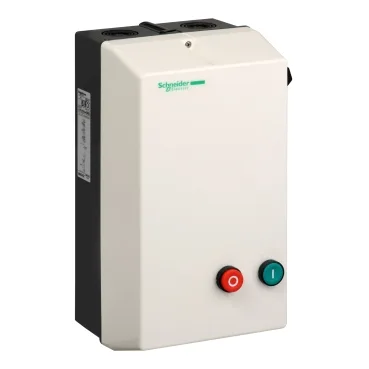
The Schneider Electric LE4D25P7 is a TeSys LE enclosed direct-on-line starter rated for 25 A conventional free air thermal current (Ith) and a 230 V AC 50/60 Hz control coil. It ships as a pre-assembled unit containing an LC1D contactor, a fuse carrier, and two pushbuttons (green start, red stop/reset) inside an IP65 polycarbonate enclosure — ready to bolt onto a machine frame or wall and wire into a motor circuit. The AC-3 utilisation category means it is designed for starting and stopping squirrel-cage induction motors under full load. Across common supply voltages it handles: 11 kW at 380/400/415/440 V AC, 15 kW at 500 V AC, and 5.5 kW at 220/230 V AC — all at 50/60 Hz.
Sourcing Reality — Obsolete, But Available
Because the part is obsolete, there is no official direct replacement order code from Schneider for this exact enclosed assembly. If you need a functional equivalent, you would typically build it from current TeSys components: a separate LC1D contactor, a thermal overload relay, a fuse disconnector, and an enclosure — but that changes the footprint and wiring. For a like-for-like swap on an existing line, the surplus path is your cleanest option.
The 25 A Ith rating sets the continuous current the starter can carry in free air. That matches the 25 A aM fuse recommendation (10 x 38 mm) — the fuse protects the starter against short-circuits, not overloads. Overload protection is handled by a separate thermal overload relay ordered with the starter, so when you source this unit make sure the overload relay (typically a TeSys LR series) is included or sourced alongside it. IP65 and IK07 mean the enclosure is dust-tight and protected against low-pressure water jets from any direction, plus impact resistance up to 2 J. That is sufficient for most indoor industrial environments — machine shops, packaging lines, conveyor stations — where washdown is occasional, not continuous. The polycarbonate housing holds up well against mild chemical splashes but is not rated for aggressive solvents or high-pressure steam cleaning. The ambient operating range is -5 to 40 °C. If your motor control cabinet sits near a furnace, kiln, or unventilated roof in summer, you will need to derate or move the starter. The cable entries (eight knockouts total — ISO20, ISO25, ISO32, ISO40 on both top and bottom) give flexibility for routing motor and control wiring without drilling the enclosure.
Integration Notes
Dimensions are 330 mm high by 186 mm wide by 175.5 mm deep. That is a compact footprint for a fully enclosed starter — it mounts directly to a backplate or machine frame via the four corner slots. The 230 V AC control coil pulls from the same supply as the motor power; verify your control transformer can handle the inrush if you are ganging multiple starters on one circuit. Compliance to IEC 60947-4-1 covers the electromechanical contactor and starter combination standard. No UL or CSA listing is stated in the documentation, so if your site requires a UL 508 listed starter for a North American panel, this unit may not satisfy that inspection point — check your local code.