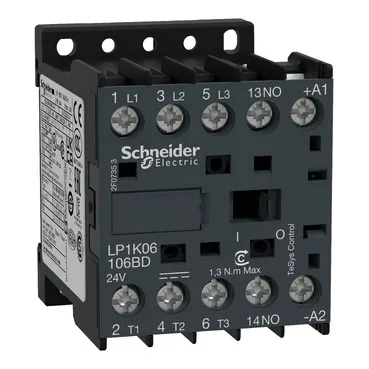
The LP1K09106BD is a TeSys K 3-pole contactor from Schneider Electric, rated for 9 A in AC-3 and AC-3e utilisation categories at 440 V, with a 24 V DC coil and one normally open auxiliary contact. The 3 NO power poles and 1 NO auxiliary contact give you the basic switching complement for a standalone motor starter or for integration into a larger control scheme.
The 9 A AC-3 rating is the headline number that governs motor switching capacity — it is not a continuous thermal current but the rated operational current for making and breaking motor circuits. The contactor also carries AC-3e (enhanced) and AC-4 (inching/plugging) ratings, with electrical durability figures that drop sharply as duty gets harder: 1.3 million cycles at 9 A AC-3, 160,000 cycles at 20 A AC-1, and only 20,000 cycles at 54 A AC-4.
Coil and control circuit details
The control circuit voltage limits are 0.8 to 1.15 times the rated control voltage (Uc) for operation, and dropout occurs at or above 0.1 times Uc below 50 °C. There is no built-in suppressor module on the coil, so you will need to add a free-wheeling diode or RC snubber externally to protect the DC control circuit from inductive kickback. The coil energisation time is 30 to 40 ms for NO closing, and de-energisation (NO opening) takes 10 ms.
Mounting, protection, and environment
Operating temperature range is -25 to 50 °C, storage from -50 to 80 °C, and it can be used at altitudes up to 2000 m without derating. The terminals accept lugs or ring terminals with a 7 mm outer diameter.
Standards and safety data
The contactor complies with EN/IEC 60947-4-1 and -5-1, UL 60947-4-1 and -5-1, CSA C22.2 No 60947-4-1 and -5-1, and GB/T 14048.4. For functional safety applications, the B10d value is 1,369,863 cycles with nominal load and 20,000,000 cycles with mechanical load per EN/ISO 13849-1. The minimum switching current is 5 mA and minimum voltage 17 V for signalling circuits, which matters when the auxiliary contact drives a PLC input or a low-power relay. Flame retardance is V1 per UL 94 and meets NF F 16-101/102 requirements.