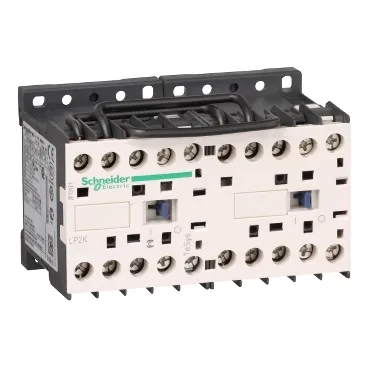
Its 72 V DC coil includes a built-in bidirectional peak limiting diode suppressor, so you don't need to add external flyback suppression on the control side — saves a component and a wiring step. Rated for AC-1 resistive loads, it breaks 110 A at 440 V and makes 144 A AC, with an electrical durability of 0.3 million cycles at 20 A under 440 V. Mechanical durability is 5 million cycles. The contactor is certified to IEC 60947, VDE 0660, NF C 63-110, and BS 5424, with a rated insulation voltage of 690 V per IEC 60947-4-1 and 600 V per UL 508 and CSA C22.2 No 14.
The preassembled reversing busbar means you don't have to wire the mechanical interlock and power crossover separately — it's one unit to torque down. Screw clamp terminals accept 1.5 to 4 mm² solid or 0.75 to 4 mm² flexible without ferrules; with ferrules, 0.34 to 2.5 mm² single or 0.34 to 1.5 mm² doubled. Tightening torque is 1.3 N·m with a Philips No 2 or a 6 mm flat screwdriver. Heat dissipation is 3 W at 20 °C coil inrush, and the average power-circuit impedance is 3 mΩ at 20 A 50 Hz — negligible voltage drop for control loads.
For a BOM freeze or second-source gate, the key fit parameters are the 72 V DC coil, 4-pole changeover form, and the preassembled reversing busbar — any substitute must match those three constraints. No direct pin-compatible alternate is listed as an official cross; verify against the panel wiring if swapping families.
The AC-1 utilisation category means it's rated for resistive loads (heaters, lighting, non-inductive). For motor or inductive loads, you'd need the AC-3 rating — this part doesn't carry one, so don't spec it for direct motor switching without derating or a different contactor. The mechanical interlock is built into the reversing assembly — no external linkage to add. Operating time is 30 to 40 ms for coil energisation and NO closing, 10 ms for de-energisation and NO opening. Maximum operating rate is 3600 cycles per hour. Control voltage limits: pick-up at 0.8 to 1.15 times Uc (57.6 to 82.8 V DC), drop-out at 0.1 to 0.75 times Uc (7.2 to 54 V DC) below 50 °C. Overvoltage category III, so it's suitable for fixed-installation distribution panels. Safety reliability: B10d of 1,369,863 cycles at nominal load per EN/ISO 13849-1, and 20 million cycles with mechanical load only. Flame retardance is V1 per UL 94, and it meets NF F 16-101/102 Requirement 2 for railway fire behaviour. Associated fuse rating is 25 A gG (general purpose) or 25 A aM (motor protection) for the power circuit. Altitude rating is 2000 m without derating. Protective treatment is TC per IEC 60068 and DIN 50016 for tropical climate resistance.