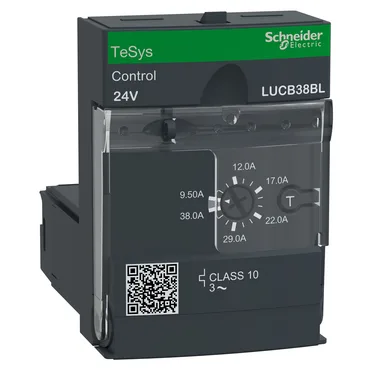
It's the part that decides when to trip, not the power contactor itself. Rated for utilisation category AC-43 per IEC 60947-6-2, meaning it's built for the high inrush and inductive load of a motor start — not a resistive heater bank. The thermal overload class is Class 10, temperature-compensated from -25 to 70 °C, so it tracks motor heating accurately across the panel's ambient range. Tripping threshold is set at 14.2 x Ir ±20 %, which gives a short-circuit protection band that coordinates with upstream breakers. Phase failure and phase imbalance sensitivity are built in — no add-on module needed for that.
Motor power: 18.5 kW at 400-440 V AC, 18.5 kW at 500 V, and 22 kW at 690 V. That's the motor nameplate kW it can protect — size your motor within these bands and the thermal curve matches. The control circuit runs on 24 V DC, drawing 220 mA peak while closing (with the LUB38 interface) and 80 mA sealed. Mounts via plug-in front face onto a TeSys Ultra base — no tools needed for replacement, which is the whole point when a line-down swap is measured in minutes. IP20 on the front panel and wired terminals, IP40 outside the connection zone. That's fine for a clean IP54 or IP65 enclosure; it's not rated for washdown itself. Safe separation of circuits at 400 V SELV between control and main circuits per IEC 60947-1 — important when the PLC side needs to stay isolated from motor power.
Compliance documentation covers the major industrial markets: IEC 60947-6-2, UL 60947-4-1 with phase barrier, CSA C22.2 No 60947-4-1 with phase barrier. Fire resistance at 960 °C on live-part supports, 650 °C elsewhere per IEC 60695-2-12.