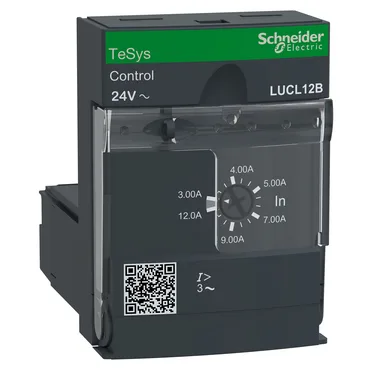
It is rated for 5.5 kW at 400...440 V AC, 5.5 kW at 500 V AC, and 9 kW at 690 V AC, all at 50/60 Hz, with a 24 V AC control circuit. The utilisation categories AC-44, AC-43, and AC-41 cover the full range of motor switching duties from resistive to severe inching and plugging. The plug-in front-face mounting means this unit snaps onto a TeSys U base without tools, keeping the wiring on the base undisturbed when the control unit is swapped — a time-saver during troubleshooting or motor replacement on a production line.
The IP20 front panel and wired terminals (IP40 outside the connection zone) keep live parts protected inside the enclosure while allowing access to the reset button and status indication. The control circuit draws 140 mA peak inrush (220 mA with LUB32/LUB38) and 70 mA sealed (90 mA with LUB32/LUB38) at 24 V AC — a modest load for a 24 V AC control transformer, but worth checking the transformer VA budget if several units share one supply.
The AC-44 utilisation category is the most demanding standard motor-starting duty — it covers inching and plugging where the motor sees repeated high-inrush current. The LUCL12B is rated for that, so it is not limited to simple on-off pump or fan duty; it handles reversing and jogging applications without derating. The tripping threshold of 14.2 x Ir +/- 20 % sets the magnetic short-circuit release at roughly 14 times the thermal setting, which is typical for motor-starting inrush and avoids nuisance trips on start-up while still clearing a bolted fault fast. Rated insulation voltage (Ui) is 690 V per IEC 60947-6-2, 600 V per UL 60947-4-1 and CSA C22.2 No 60947-4-1 — the part is suitable for 480 V and 600 V North American systems as well as 400 V and 690 V European networks, with the phase barrier required for the UL/CSA listing. The product-specific application is protection of variable speed drive or soft-start/soft-stop units — not just across-the-line motor starting. This means the LUCL12B is designed to coordinate with the reduced inrush and harmonic content of a VSD output, a detail that matters when selecting the control unit for a drive-fed motor branch.