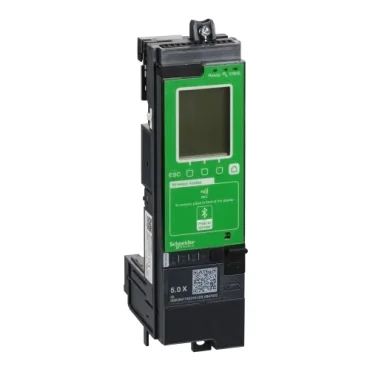
Trip unit rating spans 400 A to 6300 A — but that's the breaker frame it mates to, not a single setting. The MicroLogic 5.0 X adjusts the long-time pickup (Ir) from 0.4 to 1 x In in 1 A steps, so one unit covers a wide range of cable and load sizes. The 12.5 to 600 s delay at 1.5 x Ir lets you coordinate with downstream feeders. Metering accuracy is Class 0.5 for voltage and current, Class 1 for active power and energy. That's better than a typical panel meter — you can use this for submetering without a separate power analyzer. The LCD display (128 x 96 pixels) shows all the usual suspects: V, A, W, VAR, VA, PF, Hz, THD, demand, and harmonics. Communication is via Bluetooth 4.0 LE, NFC, and USB — no gateway needed for local setup and data pull. The USB port at 115 kbaud is handy for commissioning: plug in a laptop, pull the event logs, set the protection curves, and walk away.
Protection and diagnosis depth
LSI protection covers overload (long-time), delayed short-circuit (short-time), and instantaneous. Zone selective interlocking (ZSI) is included — that's the feature that lets breakers on the same bus communicate to clear a fault at the closest device while keeping upstream breakers closed for selectivity. Without ZSI, you'd need longer time delays that stress the gear. The diagnosis suite is extensive: trip cause indication, breaker health state, contact wear, MicroLogic service life, alarm logs, event logs, min/max of instantaneous values, and a maintenance log. For a facility engineer, that means you can trend contact wear and schedule PM before a trip event, not after. Thermal memory is standard — if the breaker trips on overload and is reclosed quickly, the trip unit remembers the heat still in the conductors and reduces the allowable time before a second trip. That prevents nuisance re-tripping on a hot cable.