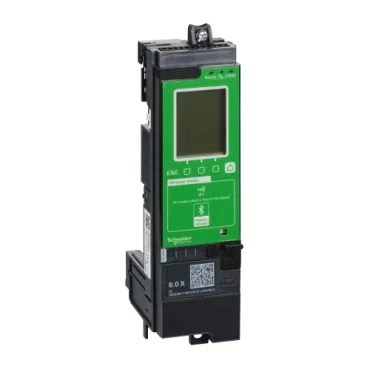
The LV839211 is a Schneider Electric MicroLogic 6.0 X control unit, the brains inside a MasterPacT air circuit breaker. It's an electronic trip unit — not the breaker itself — that handles protection, metering, and communication for the assembly it's plugged into. Rated for the full MasterPacT frame range, the trip unit works with breaker ratings from 400 A up to 6300 A, covering MTZ1, MTZ2, and MTZ3 frames. That means one control unit type fits across multiple breaker sizes, simplifying spares stocking for a panel builder or facility.
Protection profile — LSIG with adjustable timing
The LV839211 provides LSIG protection: Long-time (overload), Short-time (short-circuit with delay), Instantaneous (high-level fault), and Ground fault. Each function is adjustable — long-time delay in 0.5 s steps, short-time delay adjustable, and ground-fault pickup adjustable — so the trip curve can be tuned to the load and selectivity scheme. Zone Selective Interlocking (ZSI) is built in, which lets multiple breakers in a cascade communicate to clear a fault at the closest device without waiting for a time delay. That keeps arc-flash energy lower and speeds up fault isolation in a distribution lineup. Thermal memory is included, meaning the trip unit remembers the thermal state of the conductor even after a trip event — prevents re-closing into a still-hot circuit and avoids nuisance trips on fast re-energization.
Communications and integration
Onboard communication includes Bluetooth 4.0 LE (30 kbit/s peer-to-peer), NFC (ISO 15963), and USB (115 kbaud). That means you can pull data or change settings with a phone or tablet via the Schneider EcoStruxure app, or connect a laptop directly via USB — no gateway required for local access. The measurement voltage range is 208–828 V AC phase-to-phase and 120–480 V AC phase-to-neutral, at 50/60 Hz. The unit is powered from the breaker's own voltage taps — no separate control power supply needed for the metering section.
Relative humidity tolerance is 95 % at 55 °C per IEC 60068-2-30. Maximum operating altitude is 5000 m with voltage derating above 2000 m. Electromagnetic compatibility covers electrostatic discharge, radiated and conducted immunity, electrical fast transients, surges (1.2/50 µs), and conducted RF disturbances per IEC 61000-4-2 through -6. Conducted and radiated emissions meet Class A per CISPR 22.