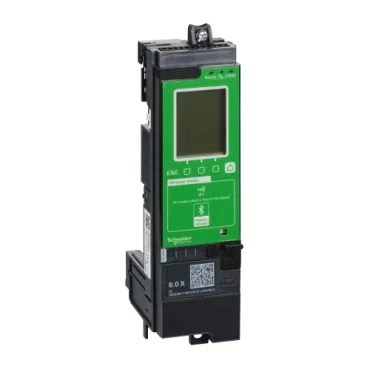
The Schneider Electric LV839217 is a MicroLogic 6.0 X electronic control unit for MasterPacT air circuit breakers. It provides LSIG protection — long-time, short-time, instantaneous, and ground-fault — with a trip unit rating range from 400 A up to 6300 A depending on the breaker frame it's installed in. This is the brain that measures, protects, and communicates for the breaker. It's a fixed-mount power meter and protection relay in one package, with a 128 x 96 pixel LCD display that shows real-time electrical parameters: current per phase (I1, I2, I3, Iavg), neutral current IN, ground fault current Ig, line-to-line and line-to-neutral voltages, active/reactive/apparent power, energy, power factor, frequency, and harmonic distortion up to the 31st order. Measurement accuracy is ±0.5% for current and voltage, ±1% for active power and energy, ±2% for reactive power and power factor. That's Class 0.5 for voltage unbalance, Class 1 for active energy by pulse counting, and Class 5 for total current harmonic distortion.
Protection functions and coordination
The LSIG protection suite covers overload (long-time, ANSI 49), instantaneous short-circuit (ANSI 50), short-time short-circuit (ANSI 51), and earth fault (ANSI 51N). Long-time delay is adjustable in 0.5 s steps with a range of 12.5–600 s at 1.5×Ir, and 0.5–24 s at 6×Ir. Short-time delay is adjustable. Ground-fault pickup is adjustable. Zone selective interlocking (ZSI) is built in, which lets multiple breakers in a selective scheme communicate trip status to minimize arc-flash energy and clear faults faster while maintaining coordination. Neutral protection is configurable: 1×Ir for 4P4d, 0.5×Ir for 4P3d+N/2, 1.6×Ir for 4P3d+OSN, or no protection for 4P3d. The protected poles description covers 4P4d, 4P3d+OSN, 4P3d, 4P3d+N/2, and 3P3d — so you can match the breaker configuration to the system grounding and load requirements.
Metering, data logging, and diagnostics
The unit records min/max of instantaneous values, maintenance logs, alarm logs, data logs, and event logs with time stamping. Thermal memory is included, so the trip curve accounts for prior heating when re-energizing after a trip — critical for motor and transformer protection where inrush can cause nuisance trips on a cold breaker. Network and machine diagnostics cover system HMI health state, circuit breaker health state (contacts, MicroLogic service life, tripping cause indication), identification card diagnostic data, configured alarms, monitored function diagnostics, operation diagnostics, MicroLogic test, protection test, selectivity test, trip context information, and breaker service life. This is the data stream a plant engineer needs for predictive maintenance and post-event analysis — full part genealogy for the breaker's operating history.
Communication and connectivity
Communication ports include Bluetooth 4.0 LE (peer-to-peer, 30 kbit/s), NFC (peer-to-peer, ISO 15963), and USB (peer-to-peer, 115 kbauds). That means you can pull data via a smartphone app for commissioning or troubleshooting without opening the panel door — practical for field service techs who need fault isolation without breaking the arc-flash boundary. Electromagnetic compatibility is verified: electrostatic discharge immunity per IEC 61000-4-2, radiated RF immunity per IEC 61000-4-3, fast transient/burst per IEC 61000-4-4, surge 1.2/50 µs per IEC 61000-4-5, conducted RF per IEC 61000-4-6, and conducted/radiated emissions Class A per CISPR 22.
Environmental and installation limits
Operating ambient temperature is -25 to 70 °C, with start-up capability down to -35 °C. Relative humidity tolerance is 95% at 55 °C per IEC 60068-2-30. Maximum operating altitude is 5000 m with voltage derating to 560 V AC above 2000 m. Measurement voltage range is 208–828 V AC phase-to-phase, 120–480 V AC phase-to-neutral, 50/60 Hz. Frequency measurement range is 40–70 Hz.