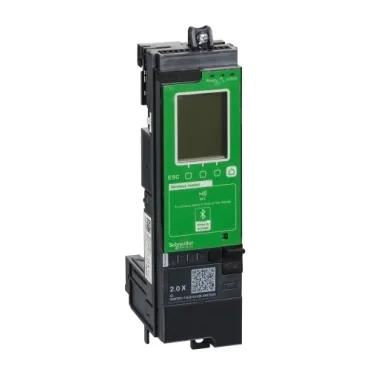
The Schneider Electric LV839218 is a MicroLogic 2.0 X electronic control unit for the MasterPacT range of air circuit breakers. It's the brains that handles protection, metering, and communication for the breaker assembly it's mounted in. This is a fixed-mount control unit, not a plug-in module — it's intended to be installed into the breaker cradle and stay there. It provides LI protection (long-time and instantaneous short-circuit), per ANSI 50 and 49 respectively. The unit is rated for distribution applications per IEC standards, and carries approvals to EN/IEC 60255-1, 60947-1, 60947-2, and 60092-202 (marine applications).
The trip unit rating covers a wide range: 400 A, 630 A, 800 A, 1000 A, 1250 A, 1600 A, 2000 A, 2500 A, 3200 A, 4000 A, 5000 A, and 6300 A. This means the same control unit can be matched to different breaker frames (MTZ1, MTZ2, MTZ3) by selecting the appropriate rating plug — the control unit itself isn't frame-specific, but the rating plug determines the maximum continuous current it can protect. The long-time pickup (Ir) is adjustable from 0.4 to 1 x In in 1 A steps, and the long-time delay (tr) is adjustable in 0.5 s increments. The instantaneous pickup (Ii) is also adjustable. This gives the commissioning engineer fine-grained control over the protection curve to coordinate with downstream devices. Measurement accuracy is class-leading for a built-in trip unit: current measurement within ±0.5% across the full range, voltage within ±0.5%, active power within ±1%, and reactive power within ±2%. The LCD display (128 x 96 pixels) shows all metered values locally — no external display needed for basic commissioning checks.
Metering and communication
This control unit is a full power meter. It measures all three phase currents, neutral current, ground fault current, all phase-to-phase and phase-to-neutral voltages, active/reactive/apparent power per phase and total, power factor, frequency, energy (import/export/total), demand current and power, total harmonic distortion for current and voltage, and unbalance. That's enough data to feed a building management system or a plant SCADA without an additional power meter. Communication is via Bluetooth 4.0 LE (30 kbit/s), NFC (28800 baud), and USB (115 kbaud). The Bluetooth link is useful for commissioning from a tablet without opening the panel door — you can read all metering, adjust protection settings, and view event logs wirelessly. NFC is handy for quick parameter transfer via a smartphone app. The unit logs data, alarms, events, min/max values, and maintenance data with time stamps. Thermal memory is included, so the trip unit remembers the thermal state of the protected conductor even after a power loss — critical for accurate overload protection on re-energization.
The unit is rated for operation from -25 °C to 70 °C (with -35 °C start-up capability) and up to 95% relative humidity at 55 °C. Operating altitude is up to 5000 m with voltage derating above 2000 m. This covers most industrial and marine installations without special derating.
Poles and neutral configuration
The LV839218 supports multiple pole configurations: 4P 4d (four poles, four protected), 4P 3d (four poles, three protected — solid neutral), 4P 3d + N/2 (four poles, three protected with half-rated neutral), 4P 3d + OSN (four poles, three protected with oversize neutral), and 3P 3d (three poles, three protected). The neutral protection setting is selectable: 1 x Ir, 0.5 x Ir, 1.6 x Ir, or no protection. This flexibility lets the same control unit work in 3-wire delta, 4-wire wye, or corner-grounded delta systems.
Environmental and EMC
EMC compliance covers electrostatic discharge (IEC 61000-4-2), radiated fields (IEC 61000-4-3), fast transients (IEC 61000-4-4), surge 1.2/50 µs (IEC 61000-4-5), conducted RF (IEC 61000-4-6), and conducted/radiated emissions Class A per CISPR 22. This is a robust industrial EMC profile — no issues in typical plant-floor environments with VFDs, welders, or contactors nearby.