What the LSIG protection curve means for your coordination study
LSIG gives you four independently adjustable protection elements: long-time (overload, ANSI 49) with a delay adjustable in 0.5 s steps; short-time (ANSI 51) with adjustable delay and pick-up; instantaneous (ANSI 50); and ground-fault (ANSI 51N) with adjustable pick-up. Zone selective interlocking (ZSI) is included, so downstream faults are cleared at the instantaneous speed of the closest breaker while upstream breakers hold their coordination — critical for minimizing arc-flash energy in a selective system. The long-time delay adjustment range runs from 12.5 to 600 s at 1.5 x Ir, and 0.5 to 24 s at 6 x Ir, with a separate 0.7 to 16.6 s band at 7.2 x Ir. That gives the protection engineer fine granularity for coordinating with downstream MCCB or fuse curves, especially on motor-start or transformer-inrush profiles where a standard fixed-delay curve would nuisance trip.
Lifecycle and sourcing — active, not a phase-out watch
Approvals cover the major industrial jurisdictions: EN/IEC 60947-2 (circuit-breaker standard), EN/IEC 60947-1 (general rules), EN/IEC 60255-1 (measuring relays), and EN/IEC 60092-202 (marine electrical installations).
Integration into the MasterPacT cradle — what the wireman needs
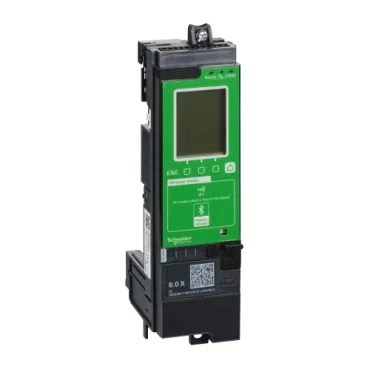
The MicroLogic 6.0 X is a fixed-mount control unit that plugs directly into the MasterPacT breaker cradle. No separate DIN-rail mounting or panel wiring for the trip unit itself — the power and CT connections are made through the cradle's internal bus. The protected poles configuration is selectable: 3P 3d, 4P 3d, 4P 3d + N/2, 4P 3d + OSN, or 4P 4d, set via the neutral protection setting on the front panel. Measurement voltage range is 208–828 V AC phase-to-phase and 120–480 V AC phase-to-neutral at 50/60 Hz. The operating altitude rating goes to 5000 m with voltage derating above 560 V AC. Ambient temperature for operation is -25 to 70 °C, with start-up capability down to -35 °C — relevant for outdoor switchgear in cold climates.
Current measurement accuracy is ±0.5 % across the full range for MTZ1 (40–1600 A) and MTZ2 (40–4000 A) frames, and ±0.5 % for MTZ3 (80–6300 A). Voltage accuracy is ±0.5 % on both phase-to-phase and phase-to-neutral measurements. Active energy is ±1 %, reactive energy ±2 %. Total harmonic distortion measurement is Class 5 for current, Class 2 for voltage — sufficient for power-quality surveys and demand-side management, though not precision-laboratory grade. The metering covers everything a facility energy manager needs: per-phase and average RMS current, neutral current, ground-fault current, three voltage modes (LL and LN), active/reactive/apparent power and energy per phase and total, power factor, frequency (40–70 Hz range), phase sequence, demand values, and both current and voltage THD. Data logging includes event logs, alarm logs, min/max of instantaneous values, and time-stamped maintenance logs.