What the 800 A and 100 kA ratings mean for your main breaker
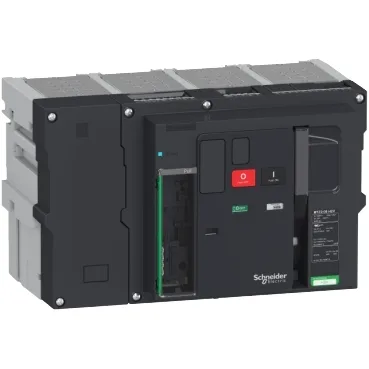
The LV846190 is a Schneider Electric MasterPact MTZ2 drawout circuit breaker rated 800 A at 40 °C with an H2V performance class delivering 100 kA at 415 V AC. Category B selectivity means it's designed for full discrimination with downstream breakers, so only the faulted branch opens, not the whole board. The drawout mounting lets you rack the breaker in and out of the cassette without disconnecting power cables — a key feature for switchgear where you need to isolate for maintenance or swap a unit without de-energizing the bus. The IP30 enclosure is standard for indoor switchgear; it keeps fingers out but isn't rated for washdown.
Sourcing and lifecycle — still in current production
Compliance documentation is covered by the listed standards: EN/IEC 60947-1, EN/IEC 60947-2, EN/IEC 60947-2 Annex H, and IEC 61557-12.
Integration — panel space and connection
Physical footprint: 556 mm wide, 439 mm high, 403 mm deep. That depth (403 mm) is the overall dimension including the drawout cradle — verify your switchgear cubicle depth allows for the racking mechanism travel. Mounting support is on rails or a base plate, typical for withdrawable switchgear. Connection pitch is 115 mm, which matches standard busbar spacing for this frame size. Both upside and downside connections accept front or rear termination, giving flexibility for cable or busbar entry. Power dissipation is 100 W at rated current — that's the heat the breaker dumps into the enclosure at full load. The sensor rating is listed as 400 A, 630 A, 800 A, meaning the breaker frame accepts interchangeable rating plugs or sensors to adjust the continuous current without changing the whole unit — useful if your load grows later.
Durability and fault ratings for the maintenance planner
Mechanical durability is 15,000 cycles with periodic preventive maintenance. Electrical durability: 10,000 cycles at 440 V AC under AC-23A (making/breaking motor loads), and 6,000 cycles under AC-3 (direct motor switching) per EN/IEC 60947-3. That's a heavy-duty cycle — suitable for frequent switching applications like capacitor banks or motor feeders, not just infrequent fault protection. Short-time withstand (Icw) is 100 kA for 0.5 s and 1 s, and 75 kA for 3 s — that tells you how long the breaker can carry a fault current without damage while downstream breakers clear. Making capacity (Icm) is 220 kA at 220/415 V and 440 V AC, which is the peak asymmetrical current the breaker can close into and latch. Rated impulse withstand voltage (Uimp) is 12 kV, insulation voltage (Ui) 1000 V AC. Operating altitude is 0-2000 m without derating, 2000-5000 m with derating.