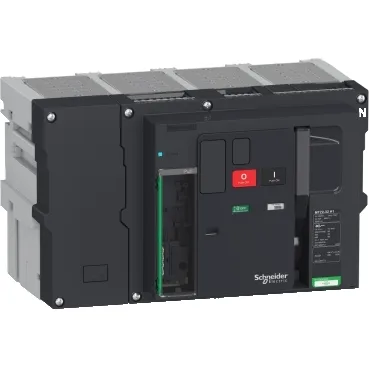
The Schneider Electric LV848229 is a MasterPact MTZ2 4-pole drawout circuit breaker rated 1600 A at 40 °C, built for main or feeder protection in power distribution. It carries an H1 performance class with 66 kA breaking capacity across the full voltage range up to 690 V AC — that means it clears faults at that level without needing an upstream device to trip first, which is the definition of Category B selectivity per EN/IEC 60947-2.
Service breaking capacity (Ics) holds 66 kA at every common voltage point — 220/415 V, 440 V, 500/525 V, and 660/690 V — so coordination studies stay simple across mixed-voltage installations. Short-time withstand (Icw) is 66 kA for 0.5 s and 1 s, 36 kA for 3 s, giving downstream breakers time to clear before the main opens. Making capacity (Icm) reaches 145 kA peak at all listed voltages, matching the peak asymmetry on a fully offset fault. Maximum break time is 25 ms; closing response maxes at 70 ms. Power dissipation runs 390 W at rated current — factor that into enclosure ventilation, especially in a multi-breaker lineup.
Electrical durability is 10,000 cycles at 440 V and 690 V AC under EN/IEC 60947-2, with 6,000 cycles in AC-3 motor-switching duty. Mechanical durability reaches 25,000 cycles with periodic preventive maintenance. The drawout chassis allows racking the breaker in and out without disturbing power connections — standard for switchgear where a spare breaker sits in the compartment.
Mounts on rails or a base plate in drawout configuration. With chassis, the footprint is 556 mm wide, 439 mm high, 403 mm deep; without chassis it shrinks to 493 mm wide, 300 mm high, 300 mm deep. Connection pitch is 115 mm. Neutral sits on the right. IP30 protection keeps out tools and fingers but not water — install in a dry switchgear enclosure. Sensor rating options are 800 A, 1000 A, 1250 A, and 1600 A — the breaker frame accepts any, so you can down-rate the trip unit for a smaller load and re-rate later. Upside and downside connections accept front or rear cabling, which simplifies busbar routing in common switchgear layouts.