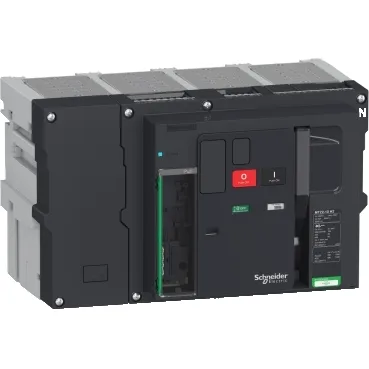
The Schneider Electric LV848438 is a MasterPacT MTZ2 H2 drawout circuit breaker, rated 2000 A at 40 °C, 4 poles, with a performance class of H2 delivering 100 kA Ics at 415 V AC. This is a Category B breaker (selective coordination capable), meaning it's designed for main or tie positions in a distribution switchboard where you need fault discrimination downstream. The drawout chassis lets you rack the breaker out for maintenance or replacement without disturbing the bus connections — standard for utility and industrial power-entrance gear.
Breaking capacity and coordination headroom
That's a flat 100 kA across the common 415 V distribution level — no derating curve to watch at nominal voltage. Icw (short-time withstand) is 85 kA for 1 second, which gives the downstream breakers time to clear before the main trips. The making capacity (Icm) at 415 V is 220 kA peak, so it can close onto a bolted fault without welding contacts. For an integrator sizing the main breaker to a 2000 A bus, this unit gives you full selectivity with downstream 65 kA or 50 kA feeders.
Drawout mounting means the breaker slides into a fixed chassis — the chassis is ordered separately (Schneider's chassis codes for the MTZ2 frame). Connection pitch is 115 mm, with both front and rear connection options. The breaker itself (without chassis) is 300 mm deep, 493 mm wide, 300 mm high; with chassis installed, depth goes to 403 mm, width to 556 mm, height to 439 mm. Mounts on rails or a base plate in the switchgear cubicle. IP30 on the breaker body — adequate for enclosed switchgear, not for open-panel exposure.
The H2 performance level gives you 100 kA Ics at 415 V, which is the standard for large commercial and industrial mains where fault current can exceed 65 kA. Electrical durability is 8000 cycles at 440 V under EN/IEC 60947-2 — that's the mechanical life under load, not just racking cycles.
Also listed to IEC 61557-12 for power metering when equipped with the appropriate trip unit. The 12 kV rated impulse withstand voltage (Uimp) covers typical surge environments in distribution networks. Operating altitude is 0–2000 m without derating, 2000–5000 m with derating — relevant for high-altitude installations where air density affects arc extinction.