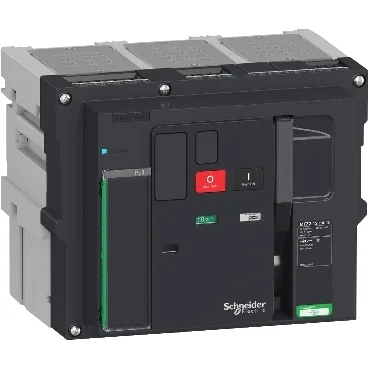
Switch disconnector for distribution — 1250 A drawout
The Schneider Electric LV848747 is a MasterPact MTZ2 12 HA10 switch disconnector rated for 1250 A at 1150 V AC, 50/60 Hz, in a three-pole drawout chassis configuration.
The 1250 A continuous rating (Ie) at 1150 V AC places this unit in the high-current distribution tier — sized for main incoming feeders or large bus risers in industrial switchgear. The AC-23A and AC-3 utilization categories mean it handles switching of motor loads and mixed resistive-inductive loads within that current envelope; AC-23A specifically covers occasional switching of individual motors and other highly inductive loads. Short-circuit performance is defined by a rated short-time withstand current (Icw) of 50 kA for 1 s and 50 kA for 3 s, plus a rated short-circuit making capacity (Icm) of 105 kA peak at 1150 V. These numbers govern selectivity coordination with downstream breakers — the switch disconnector must hold closed during a fault long enough for the downstream device to clear, without welding or degrading. Drawout mounting on a dedicated chassis (connection pitch 115 mm) allows the switching element to be racked out for maintenance or replacement without de-energizing the bus — standard practice for main and tie positions in a switchboard lineup. The contact position indicator and visible-break confirmation (per EN/IEC 60947-3) give the operator a positive mechanical indication of isolation.
The unit occupies a 441 mm wide × 439 mm high × 403 mm deep footprint on a chassis mount — sized for standard low-voltage switchgear cubicles. IP30 protection limits ingress to tools and small wires; the enclosure it mounts in provides the overall panel rating. Operating ambient temperature range is -25 to 70 °C, with storage from -40 to 85 °C — sufficient for most indoor industrial installations without derating, though the 70 °C upper operating limit may require ventilation in hot-climate or high-load cubicles. Rated impulse withstand voltage (Uimp) of 12 kV aligns with distribution-level surge coordination.