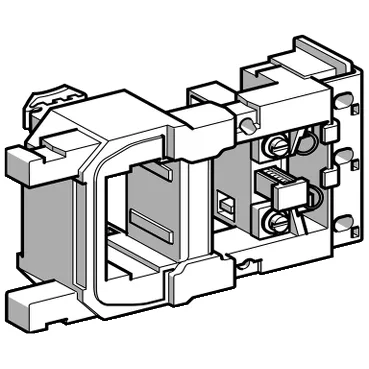
The LX0FF057 is a replacement contactor coil from the Schneider Electric TeSys F range, designed for 127 V DC low-consumption control circuits. It's the coil that drives the main contactor in a motor starter or power switching assembly — when the coil pulls in, the main contacts close; when it drops out, they open. Operating time is 35 to 40 ms for latching and 50 to 100 ms for unlatching, which is typical for a DC-operated coil of this size. Coil resistance measures 35.54 ohms for the latching winding and 1086.36 ohms for the unlatching winding at 20 °C. Control voltage limits are 0.85 to 1.1 times Uc for both latching and unlatching, meaning the coil holds in reliably between roughly 108 V and 140 V DC.
Sourcing reality — obsolete part
For a procurement decision: if this coil is on a BOM for a running TeSys F contactor assembly and the line is down, the fastest path is a broker or surplus search against the exact order code. No official manufacturer successor is listed for this specific coil variant, so a direct parametric replacement would need to match the 127 V DC control voltage and the mechanical interface of the TeSys F contactor frame.
The 127 V DC control voltage is non-standard in many regions — most industrial control systems run 24 V DC or 110/120 V AC. Verify your control transformer or DC supply delivers 127 V nominal before committing this coil to the BOM. The low-consumption design (DC coil with separate latching and unlatching windings) draws less steady-state current than a standard DC coil, which matters if the control supply is shared across multiple contactors. Operating time of 35 to 40 ms latching means the contactor closes in under two line cycles at 50 Hz. That's fast enough for most motor starting but not for high-speed synchronous transfer switching — if you need sub-20 ms closure, this coil won't deliver it. The 1-million-cycle mechanical durability is a design-life figure, not a guarantee. In a typical motor-starting application at 120 cycles per hour, that's roughly 8,300 hours of continuous operation before mechanical wear becomes a concern — enough for several years of single-shift production.