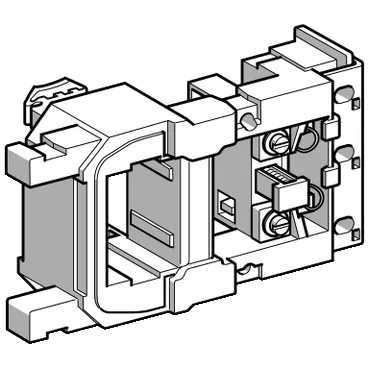
The LX0FH224 is a TeSys F contactor coil — the solenoid that pulls in and holds the main contacts of a TeSys F contactor. It uses a dual-voltage control circuit: 220 V AC/DC for latching (holding the contacts closed) and 24 V AC/DC for unlatching (releasing them). This split-voltage design is common in applications where a higher-voltage control circuit latches the contactor and a lower-voltage safety circuit drops it out, reducing coil dissipation during the holding state. Operating time is 50…100 ms for unlatching and 45…50 ms for latching, which means the coil responds fast enough for most motor-starting and process-control cycles. The control circuit voltage limits are 0.85…1.1 Uc for both latching and unlatching, so the coil holds reliably down to 85 % of nominal and trips cleanly at the upper end without overheating.
Coil resistance at 20 °C is 26 Ω for the latching winding and 29.5 Ω for the unlatching winding. That difference matters when sizing the control transformer or DC supply — the latching winding draws about 8.5 A at 220 V AC (inrush), settling to the holding current through the coil's own impedance. The unlatching winding draws roughly 0.8 A at 24 V DC. If you are replacing an existing coil, verify the winding resistances match your control circuit's current capability. That is typical for a general-purpose contactor coil in a TeSys F frame — adequate for most conveyor, pump, and fan duty, but not for high-speed pick-and-place or valve actuation exceeding 2 operations per minute.