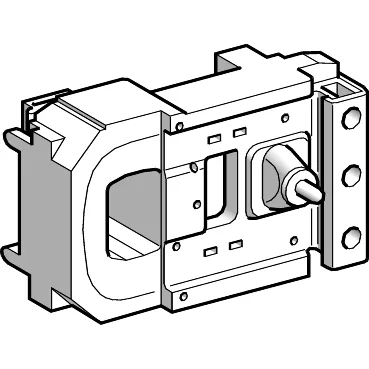
The LX0FJ060 is a replacement coil for the TeSys F contactor range, offered in a dual-voltage variant accepting 230 V or 110 V AC/DC on the control circuit at 40...400 Hz. The control circuit voltage limits are specified as 0.85...1.1 Uc for both latching and unlatching, so the coil holds in reliably across an 85% to 110% band of the nominal control voltage — useful when the control transformer is shared with other loads and may sag under peak draw. Operating time is 50...100 ms for unlatching and 40...75 ms for latching. That window matters when sequencing contactors in a reversing starter or bypass circuit: the slower unlatching edge (up to 100 ms) means the main contactor may still be closed when the reversing contactor picks up, so interlocking via auxiliary contacts or a delay-on timer is needed to prevent a phase-to-phase short.
Integration notes
The coil resistance at 20 °C is 29.72 Ohm for the latching winding and 408.7 Ohm for the unlatching winding. That difference lets you verify the correct coil is installed with an ohmmeter before energizing the panel — a quick continuity check against the table saves a blown coil if the wrong voltage variant was kitted. For a high-duty application like a rapid-reversing conveyor or a press control, check that the duty cycle stays under that rate — sustained operation above 120 cyc/h will accelerate wear and may cause the coil to overheat.