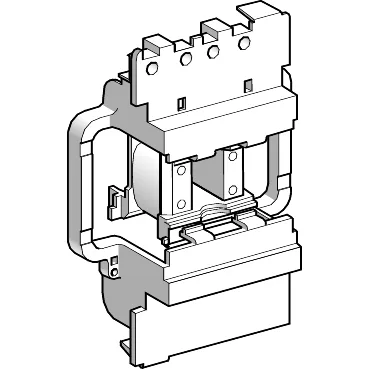
The LX1D8B6 is a TeSys Deca contactor coil — the solenoid that pulls in the main power contacts on a 115 A contactor frame. It's the part that turns the contactor on and off, so if the coil fails, the contactor doesn't close and the load stays disconnected. Rated for 24 V AC at 60 Hz control circuits. The hold-in power draw is 22 VA at 60 Hz with a 0.3 power factor; inrush at pickup hits 300 VA. That inrush spike matters when sizing the control transformer — a 50 VA transformer won't reliably pull in multiple coils simultaneously. Heat dissipation runs 3 to 8 W at 60 Hz depending on the contactor's duty cycle. In a sealed panel with multiple contactors running near their thermal limits, that waste heat adds up — account for it in the enclosure's thermal budget.
Mechanical durability is rated at 8 million cycles. That's the mechanical life of the coil's own plunger and return spring — not the electrical life of the main contacts under load. In a conveyor line cycling once every 10 seconds, that's roughly 2.5 years of continuous operation before the coil mechanism wears out. Maximum operating rate is 2400 cycles per hour at 140 °F (60 °C). That's one cycle every 1.5 seconds — fast enough for most high-speed pick-and-place or packaging lines, but if you're running a servo-driven press that cycles faster, the coil won't keep up and will overheat. Control voltage limits are 0.85 to 1.1 times Uc for operation (20.4 to 26.4 V AC) and dropout between 0.3 and 0.6 times Uc (7.2 to 14.4 V AC) at 131 °F (55 °C). If your control transformer sags below 20.4 V under inrush from other loads, the coil may chatter or fail to pick up — check the voltage at the coil terminals, not just the transformer nameplate. Coil resistance is 0.87 ohm at 68 °F (20 °C) and inductance of the closed circuit is 0.07 H. That's useful if you're calculating the coil's DC resistance for a holding circuit or verifying the coil hasn't shorted turns with an ohmmeter — a reading significantly below 0.87 ohm suggests a partial short.
Where this class of part is used
Contactor coils are the control interface between a PLC output or pushbutton and the power circuit. This one lives inside the contactor assembly on a DIN rail or panel-mounted contactor, typically in motor control centers, conveyor systems, pump panels, and HVAC equipment. The coil sees 24 V AC from a control transformer; the contactor's main poles switch the 3-phase motor load.