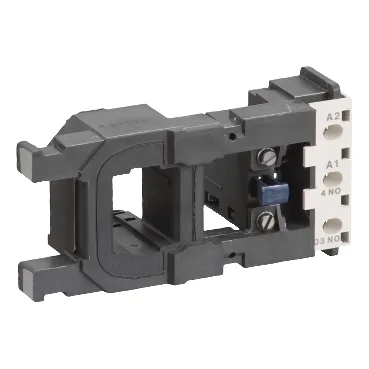
The LX1FF2206 is a replacement contactor coil from the Schneider Electric TeSys F range, designed for 220 V AC 60 Hz control circuits. It is the coil that energizes the main power contacts in a TeSys F contactor — no built-in suppressor module, so you add the RC snubber or varistor externally per the panel design. The closing time spans 23 to 35 ms, opening 5 to 15 ms, which is typical for this frame size and means the contactor responds fast enough for motor starting but not so fast it causes nuisance chatter on a sagging line.
Inrush power hits 660 VA at 60 Hz with a 0.3 power factor — that is the surge the control transformer or PLC output must deliver for the 20 ms or so the coil takes to seat. Once sealed, hold-in drops to 55 VA at the same power factor, so the steady-state load on the 24 VDC supply (if you are using an interposing relay) is modest. The coil draws about 2.9 A inrush and 0.25 A hold at 220 V — check your control transformer sizing against the inrush figure if you are driving multiple coils from one source. Drop-out voltage is 0.35 to 0.55 Uc (77 to 121 V at 220 V nominal), operational range is 0.85 to 1.1 Uc (187 to 242 V). That means the coil drops out cleanly on a brownout but stays pulled in through normal line variation. Heat dissipation runs 12 to 16 W at 60 Hz — enough that you should not pack it tight against heat-sensitive components in the enclosure without some air movement. That is a high-duty rating — suitable for frequent cycling applications like conveyor indexing or press control, not just occasional motor starting.
Integration notes for panel builders
The coil mounts directly onto the TeSys F contactor frame — no adapter plate needed. Because there is no built-in suppressor, you must add a flyback diode or RC snubber across the coil terminals if the control circuit uses a PLC or solid-state output; the 2.5 H inductance of the closed circuit will generate a significant voltage spike on de-energization without suppression. Average DC resistance is 18.9 Ω at 20 °C, useful for verifying the coil is not shorted during incoming inspection.