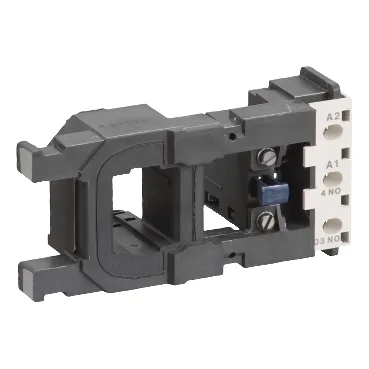
The LX1FF288 is a replacement coil for the TeSys F contactor range, wound for 288 V AC 50 Hz control circuits. It's the part that pulls the contactor in — no built-in suppressor module, so you'll need to add an RC snubber or varistor across the coil terminals if the application drives inductive loads that need suppression. Closing time runs 23 to 35 ms, opening 5 to 15 ms. The coil draws 550 VA inrush at 20 °C, then holds at 45 VA once the contactor seals. Drop-out voltage is 0.35 to 0.55 Uc at 55 °C.
Maximum operating rate is 2400 cycles per hour at 55 °C. Heat dissipation is 12 to 16 W at 50 Hz. The coil resistance is 45.97 ohms at 20 °C. That's a cold measurement — resistance rises with temperature, so the hold-in current drops as the coil warms up. The 45 VA hold-in figure already accounts for that warm condition. If you're measuring a cold coil on the bench and see lower resistance, that's normal. Inductance of the closed circuit is 5.89 H. That's the coil's inductance once the armature is seated — it's much higher than the open-circuit inductance because the magnetic circuit is closed. That inductance governs the current decay time when the coil is de-energized, which is why a freewheeling diode or snubber is needed to protect the control contacts from arcing.
Integration notes
The coil mounts directly onto the TeSys F contactor magnet assembly — it's a drop-in replacement, no tools beyond a screwdriver for the terminal screws. The 288 V AC 50 Hz winding is specific to 50 Hz mains; running it on 60 Hz will change the impedance and reduce the pull-in force. If your site is 60 Hz, this coil is not the right choice. Below -5 °C the coil may not pull in reliably due to increased resistance and stiffer grease in the contactor mechanism. Above 55 °C the insulation life derates — the coil is wound with standard class F or H insulation, but the ambient limit is the contactor's rating, not the wire itself.