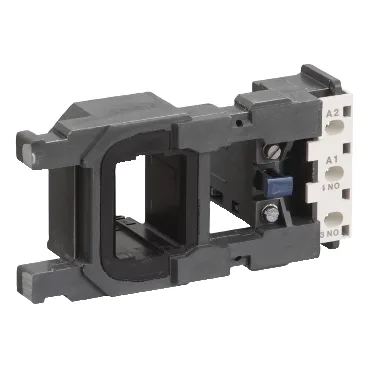
Part overview
The LX1FG288 is a replacement coil from the TeSys F range, designed to fit TeSys F contactors. It operates on a 288 V AC 50 Hz control circuit and is specified without a built-in suppressor module, meaning you'll need to add an external RC snubber or varistor across the coil terminals if driving it from a PLC output or electronic controller that requires suppression. Coil pull-in is rated at 805 VA inrush at 50 Hz (cos φ 0.3), dropping to 55 VA hold-in once the contactor seals. That inrush-to-hold ratio of roughly 15:1 is typical for AC-operated contactor coils — the control transformer or power supply must be sized for the momentary inrush, not the steady-state hold power.
Control voltage limits: the coil drops out between 0.35 and 0.55 Uc (roughly 101 to 158 V) and picks up between 0.85 and 1.1 Uc (245 to 317 V) at 55 °C. If your control supply sags below 245 V during a brownout, the contactor will drop out — plan your control transformer tap accordingly. That's about 40 operations per minute continuous — fine for most motor starting and general switching, but if you're cycling faster than that (e.g., in a rapid-indexing application), you'll need to derate or step up to a larger frame. Heat dissipation runs 18 to 24 W at 50 Hz. In a densely packed panel, that heat adds up — allow ventilation around the contactor or derate the enclosure if multiple coils are energized continuously.
Because it's a service part (category 18401-WORLD SERVICE PARTS), it's stocked as a replacement item rather than a high-volume production component. If you need a large quantity for a new panel build, confirm availability before freezing the BOM.
Integration notes
The coil has no built-in suppressor, so if your contactor is driven by a PLC or solid-state output, you must add an external suppression device (RC snubber or varistor) across A1-A2. Without it, the inductive kickback can damage the output driver or cause EMI issues on the control wiring. Operating time: 20 to 35 ms closing, 7 to 15 ms opening. If the panel ambient exceeds 55 °C, you'll need to derate or relocate the contactor — the coil's resistance and pull-in margin shift with temperature.