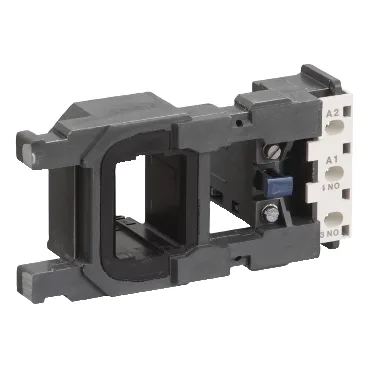
What This Coil Is and What Drives the Fit
The LX1FG750 is a replacement coil for the TeSys F contactor range, wound for a 750 V AC 50 Hz control circuit. That 750 V figure is the rated control voltage (Uc), not a coil that will pull in on 480 V and hope — the drop-out threshold sits at 0.35...0.55 Uc and the operational pickup requires 0.85...1.1 Uc, so at 750 V nominal the coil drops out somewhere between 262 V and 412 V and needs at least 637 V to pull in reliably. If your control transformer is tapped for 600 V or 480 V, this coil will not pick up. Closing time runs 20...35 ms, opening 7...15 ms. That is a standard TeSys F speed — not a fast-acting DC coil, but fast enough for motor starting and general switching where the contactor is not doing high-speed jogging. The maximum operating rate is 2400 cycles per hour at 131 °F (55 °C), which works out to one operation every 1.5 seconds; sustained faster cycling will overheat the coil.
Coil Electrical Characteristics — What the Ratings Mean
This coil uses AC 50 Hz control with no built-in suppressor module. That means you must add an external RC snubber or varistor across the coil if your PLC output or relay contact drives it — the inductive kick from a 55 VA hold-in load (805 VA inrush at cos φ 0.3) will arc a dry contact in short order. The inrush-to-hold ratio is about 14.6:1, typical for an AC coil; the closed-circuit inductance of 25.92 H confirms it is a high-inductance device, so the current decay on de-energization is slow without suppression. Heat dissipation runs 18...24 W at 50 Hz. In a densely packed panel with multiple TeSys F contactors side by side, that heat adds up — derating the ambient temperature from the rated 131 °F (55 °C) maximum may be necessary if the enclosure is sealed. The coil resistance is 185.5 Ω at 68 °F (20 °C); a cold coil draws higher inrush, so if the control voltage is marginal at the low end of the operational range, the coil may not pull in reliably on a cold start.