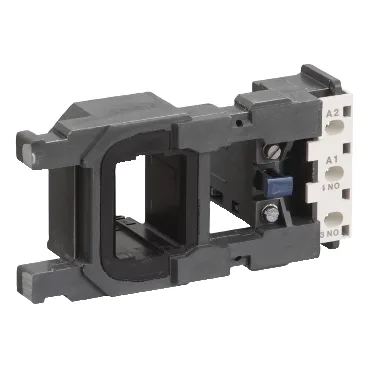
The Schneider Electric LX1FG910 is a replacement contactor coil from the TeSys F range, designed to fit the corresponding TeSys F contactor frame. It operates on a 910 V AC 50 Hz control circuit, drawing 805 VA inrush power at 50 Hz with a cos phi of 0.3, then settling to 55 VA hold-in power under the same conditions. The coil's operating time is 20 to 35 ms for closing and 7 to 15 ms for opening, which is typical for this contactor class. It has no built-in suppressor module, so if your application requires coil surge suppression, you will need to add an external RC snubber or varistor across the coil terminals. Ambient air temperature for operation spans -5 to 55 °C.
Control voltage limits and thermal behaviour
The control circuit voltage limits are specified at 55 °C: dropout occurs between 0.35 and 0.55 Uc (318 to 500 V AC), and operational range is 0.85 to 1.1 Uc (773 to 1001 V AC). This means the coil will reliably pick up at line voltages down to about 773 V and will drop out cleanly below roughly 500 V, preventing contactor chatter on a sagging line. Heat dissipation is 18 to 24 W at 50 Hz. The average coil resistance is 299.3 ohms at 20 °C, and the inductance of the closed circuit is 43.44 H. These values matter for thermal coordination inside the panel — if you are grouping multiple contactors, account for the 24 W worst-case dissipation per coil to avoid overheating the enclosure.
No last-time-buy or surplus-channel dependency applies here.
This coil mounts directly onto the TeSys F contactor magnet assembly. The 910 V AC 50 Hz control voltage is non-standard for many regions (common control voltages are 110 V, 230 V, or 400 V), so verify your control transformer taps before specifying. The coil's 805 VA inrush draw means the control transformer must be sized to handle that surge without dropping below the 0.85 Uc pickup threshold. No built-in suppressor means the coil's inductive kickback is unmanaged. If your PLC output or relay drives this coil directly, fit a suppressor across the coil — a 910 V AC rated RC snubber or a metal-oxide varistor with appropriate clamping voltage. The 18 to 24 W dissipation is conducted into the contactor frame; ensure the contactor's mounting surface has adequate airflow or thermal contact with the panel backplate.