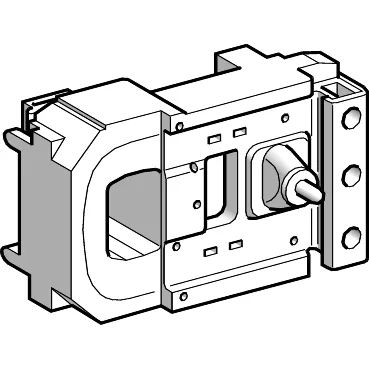
The LX1FJ660: The coil pulls 1075 VA inrush at 68 °F (20 °C) with a 0.9 power factor, then settles to 15 VA holding at 0.3 power factor — the 14 W heat dissipation figure is the real thermal load the enclosure sees continuously. That matters for cabinet temperature rise: a panel with several of these coils held in needs the dissipation budget accounted for, especially if contactors are ganged in a small enclosure. Operating voltage window is 0.85 to 1.1 Uc (561 to 726 V AC) at 131 °F (55 °C), and dropout occurs between 0.3 and 0.5 Uc (198 to 330 V AC). That wide dropout band means the coil releases reliably on a sag without needing a separate undervoltage release module — useful for coordinated motor starter schemes. Opening time spans 100 to 170 ms, closing 40 to 75 ms. That rate suits high-speed material handling or packaging lines where the contactor cycles every 1.5 seconds.
Integration notes for the wireman and the specifier
This coil carries no built-in suppressor module. On an AC control circuit, that means you need an external RC snubber or varistor across the coil terminals if the PLC output or relay driving it is solid-state — otherwise the inductive kick can weld contacts or damage the driver. For a panel builder, the 14 W dissipation and 1075 VA inrush also inform the control transformer sizing: a 100 VA transformer might not handle the simultaneous inrush of multiple coils pulling in. The average resistance is 243 ohms inrush and 6310 ohms holding at 68 °F (20 °C), with a closed-circuit inductance of 27.4 H. That inductance explains the slow current rise on pull-in — the coil is a large inductor, so the control circuit must be rated for the inrush duration, not just the steady-state holding current.