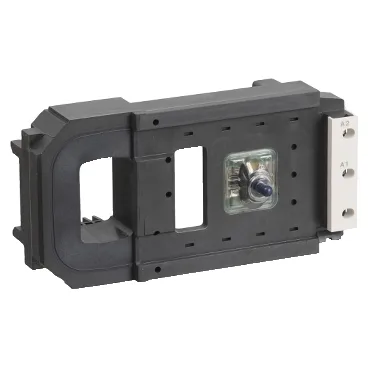
It is a bare coil without a built-in suppressor module, so you will need to add an external RC snubber or varistor across the coil terminals if driving it from a PLC output or solid-state relay — the lack of internal suppression means the inductive kickback lands on whatever switches it. Rated for 5 Mcycles mechanical durability and a maximum operating rate of 1200 cycles per hour at 55 °C, this coil is sized for continuous-duty applications like conveyor control or pump panels where the contactor cycles at a moderate pace. The AC control circuit draws from a 65 V supply — verify your control transformer taps before committing the BOM line, as a mis-matched coil voltage is a common field fault that delays commissioning.
Sourcing reality — obsolete, quoted to order
Schneider has marked the LX1FL065 as obsolete. No official successor order code exists, so this is a last-time-buy or surplus-channel part. If you are at the design stage, consider whether a 65 V AC control circuit is still the right choice for the panel.
Integration note — panel fit and wiring
The LX1FL coil snaps onto the TeSys F contactor magnet assembly — no tools needed for the coil swap, but the contactor must be de-energised and the arc chamber removed to access the coil retainer. Standard DIN-rail or screw-panel mount for the contactor itself; the coil adds no extra footprint. Wire the coil terminals to the 65 V AC control bus. Because the coil lacks a built-in suppressor, plan for a separate RC snubber across the coil terminals if the control signal comes from a PLC or proximity switch.