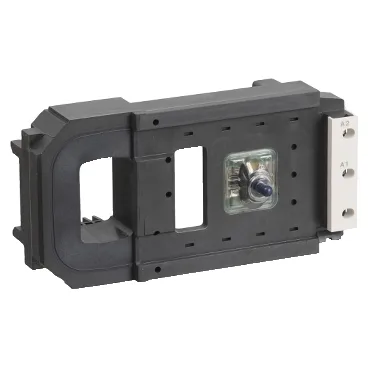
The LX1FL1000 is a TeSys F contactor coil rated for 1000 V AC control circuits at 40–400 Hz. It pulls 1650 VA inrush at cos φ 0.9, then drops to 22 VA holding at cos φ 0.3 — a 75:1 ratio that means the coil circuit needs to handle the inrush surge but the thermal load in the panel is the holding figure. The coil has no built-in suppressor module, so you'll add an RC snubber or varistor across the terminals if the PLC output or relay driving it needs transient protection. Opening time runs 100–200 ms, closing 40–80 ms — fast enough for motor starting, but not for precision sequencing where you'd spec a DC coil. Heat dissipation is 20 W across the 40–400 Hz range. That's the figure to use for enclosure thermal calculations — it's the steady-state heat the coil dumps into the cabinet, not the inrush transient.
The coil picks up reliably between 0.85 and 1.1 Uc (850–1100 V AC) and drops out between 0.25 and 0.5 Uc (250–500 V AC) at 55 °C. That wide drop-out band means the contactor stays sealed through a brownout down to roughly half nominal — useful on weak utility feeds, but it also means a downstream undervoltage relay may trip before the contactor drops if you're relying on the coil drop-out for safety. Average resistance is 474 Ω inrush and 12,880 Ω holding at 20 °C. The closed-circuit inductance is 56.2 H — that's the figure that governs the L/R time constant for the decay when you switch the coil off, which is why a suppressor is recommended.
The LX1FL coil mounts onto the TeSys F contactor frame — it's the interchangeable coil for that platform. Category classification is 22341 — contactor, D, K, & F accessories. That's the internal cataloging for the TeSys F accessory line; it confirms this is the coil, not the contactor itself.