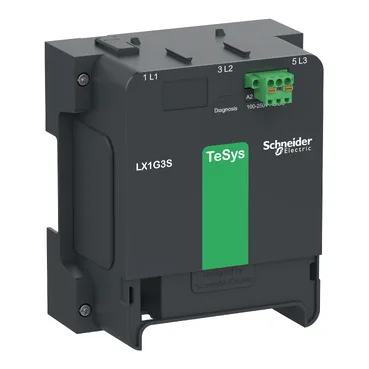
TeSys Giga Coil for LC1G400-500/3P Contactors
The LX1G3SLSEN is a control module from the TeSys Giga range, designed to drive the LC1G400-500/3P three-pole standard contactor. It operates across a wide control circuit voltage of 200-500 V AC/DC at 50/60 Hz, covering both line and DC distribution without needing a separate coil variant. The coil uses built-in bidirectional peak limiting electronics, drawing 535 VA (300 W) inrush and settling to 15.4 VA (8.6 W) hold-in power — the low hold-in reduces thermal load inside the panel and lets the contactor run cooler at sustained duty.
Termination and Panel Fit
Control circuit connections use push-in terminals accepting 0.2-2.5 mm² solid or stranded wire (AWG 26-12) and 0.25-2.5 mm² flexible with ferrules (AWG 24-14). No screw torque check needed — the spring cage holds the conductor under vibration. Dimensions are 3.7 in deep, 5.5 in wide, 6.6 in tall — the coil mounts directly on the contactor frame, adding no extra DIN-rail footprint. IP20 finger-safe protection covers the terminals.
Operating Envelope and Durability
Mechanical durability is rated at 5 million cycles, with a maximum operating rate of 600 cycles per minute at 140 °F (60 °C). Opening time spans 20-35 ms, closing 40-55 ms — consistent timing supports coordinated contactor sequencing in motor starter stacks. Ambient operating temperature range is -13 to 140 °F (-25 to 60 °C), with storage from -76 to 176 °F (-60 to 80 °C). Altitude capability reaches 3000 m without derating, 5000 m with a derating factor — relevant for high-elevation installations.
Compliance and EMC Profile
Certified to EN/IEC 60947-4-1, UL 60947-4-1A, and CSA C22.2 No 60947-4-1 — covers contactor and starter coordination for motor circuits. Pollution degree 3 per IEC 60947-1 suits industrial environments with conductive dust or humidity. EMC immunity meets IEC 60947-4-1 with emission criteria A; radiated immunity tested to 20 V/m per EN/IEC 61000-4-3. Voltage dip immunity conforms to SEMI F47 — this matters for semiconductor fab tool power quality requirements.