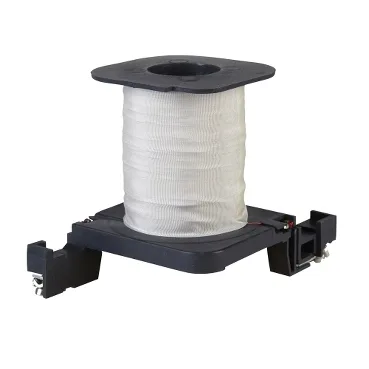
The LX4D7CD is a TeSys Deca contactor coil from Schneider Electric, designed as a 36 V DC standard replacement coil for an 80 A contactor in the TeSys range. It is a service part — category 18401-WORLD SERVICE PARTS (CTR ACCESS) — intended for field replacement or BOM sparing, not new-design procurement.
Coil technology is without built-in suppressor module, meaning the installer must provide external flyback suppression (e.g., a free-wheeling diode) across the coil terminals. Omitting this risks conducted EMI backfeeding the 36 VDC control supply and shortening PLC output life. Drop-out voltage limits are 0.1 to 0.3 Uc at under 55 °C — the coil will release the contactor armature when control voltage falls below roughly 3.6 to 10.8 VDC. For a validation engineer, this defines the undervoltage release threshold that must be documented in the control-system FMEA. Time constant of 75 ms and inductance of 4 H (closed circuit) characterize the coil's magnetic build-up and decay. In a high-speed cycling application at 3600 cycles per hour at 60 °C, the 75 ms time constant means the coil is still magnetizing for roughly the first 10% of each cycle — something to account for in timing logic if the contactor must make before a downstream device.
The part carries a lifecycle stage of 'current' in one internal system field, but the manufacturer's explicit product status is Obsolete — treat the latter as authoritative for procurement planning.
Deployment Context and Integration Notes
This coil mounts into the TeSys Deca contactor frame — it is not a standalone device. Operating ambient temperature range is -5 to 60 °C (23 to 140 °F). For a panel near a furnace or in a non-conditioned enclosure, verify that the internal panel temperature stays below 60 °C; derating is not specified but the maximum operating rate of 3600 cycles/hour is given at 60 °C. Hold-in power consumption is 22 W at 20 °C — this is the steady-state dissipation once the coil is sealed. In a dense panel with multiple contactors running continuously, the cumulative heat load from several such coils must be factored into the enclosure's thermal budget.